Digital Marketing Specialist
Shubham Srivastava is a digital marketing specialist with 3+ years of experience in the mental healthcare domain. He blends SEO expertise, social media strategy and creative storytelling to help mental health brands grow their digital presence.
25 Mar 26 07:32 am
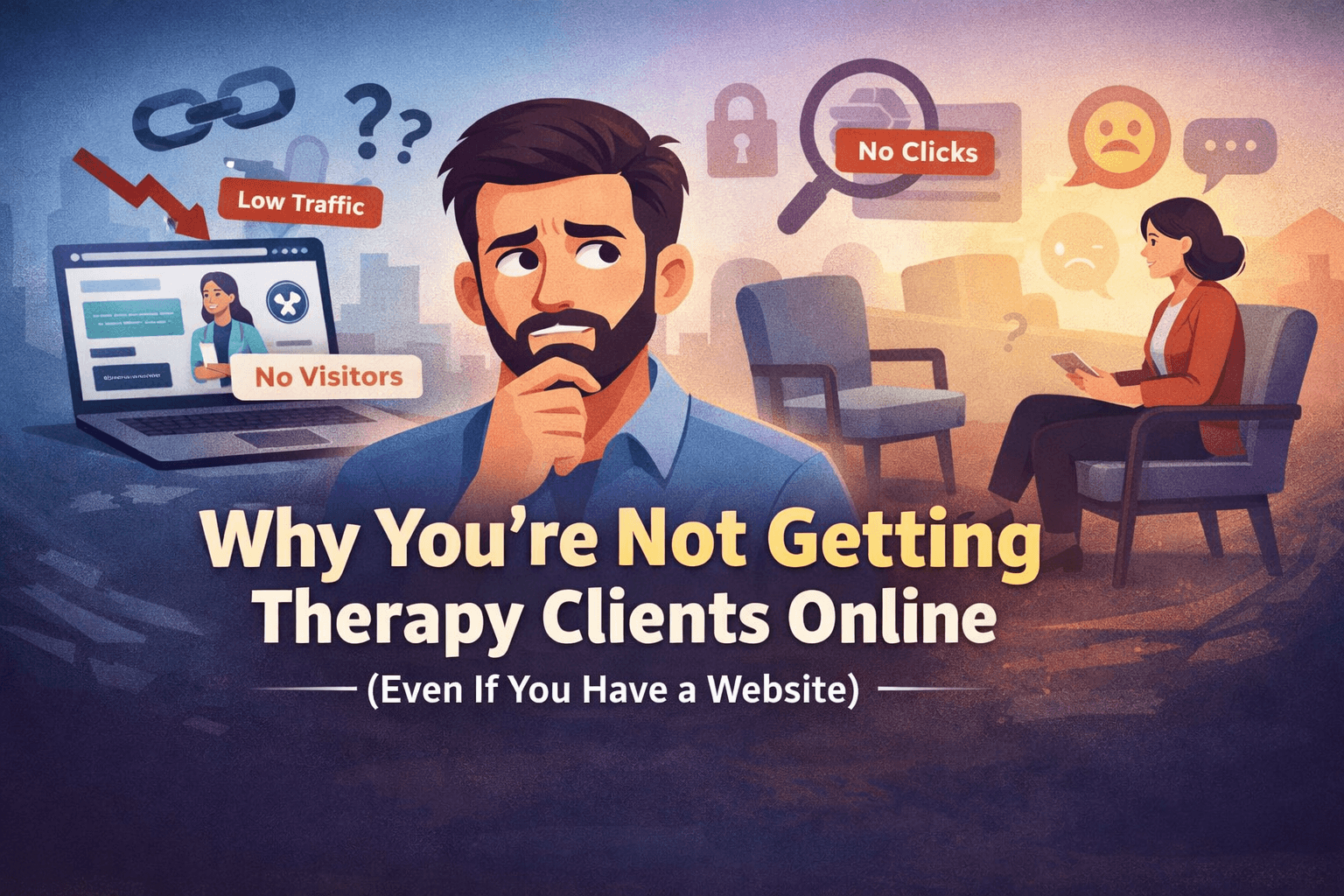
Why You’re Not Getting Therapy Clients Online (Even If You Have a Website)
Struggling to get therapy clients online? Learn why your website isn’t working and how mental health professionals can fix visibility, trust, and conversions.
On this page
Jump to sections
A few months ago, I spoke with a therapist who sounded genuinely frustrated. She told me, “Shubham, I invested in a website, I’ve listed my services, but I’m still not getting therapy clients online.”
If you’re a mental health professional, there’s a high chance you’ve felt the same. You’ve done what everyone says, built a website, maybe even tried posting content—but the results just aren’t showing.
From my experience working in the ++mental healthcare marketing++ space, I’ve learned something very important. It’s rarely about not doing enough. Most therapists are already putting in effort. The real issue is that a few critical pieces are missing, and because of that, everything else feels like it’s not working.
Let’s break this down in a simple and honest way.
1. Your Website Exists, But It’s Not Visible (SEO Problem)
Most therapists assume that once they have a website, people will find them. But the reality is very different.
When someone needs help, they search things like:
- “therapist near me”
- “online therapy India”
- “psychologist for anxiety”
These are high-intent searches. But if your website is not optimized for SEO for therapists, you simply won’t appear.
A quick fact:
++According to BrightEdge++, 68% of all online experiences begin with a search engine.
That means if you're not showing up on Google, you’re missing most potential clients.
What’s usually missing:
- No use of local keywords like “psychologist in Mumbai”
- No blog content targeting real queries
- No optimization for ++mental health services online++
So your website isn’t broken. It’s just invisible.
So the problem is not that your website doesn’t exist. The problem is that it’s not being discovered.
2. Your Website Doesn’t Build Trust the Way You Think It Does
Let’s say someone finally finds your website and clicks on it. This is a big win. But what happens next matters even more.
In those first few seconds, the person is not evaluating your degrees or certifications. They are asking themselves something much simpler: “Do I feel safe talking to this person?”
And this is where I see many therapy websites struggling.
Most websites try to sound professional, but in the process, they lose warmth. They use language that feels distant, technical, or overly formal. While it may sound correct, it doesn’t feel human. And in ++online counselling++, feeling understood matters more than sounding perfect.
I’ve noticed that the therapists who connect better online are the ones who communicate like real people. They don’t just describe what they do; they acknowledge what the client might be going through. They make the visitor feel seen.
A small shift in language can make a huge difference. When your website reflects empathy, clarity, and simplicity, trust builds naturally. And once trust is there, everything else becomes easier.
3. Your Website Is Not Converting Visitors Into Clients
Even if your website is visible and trustworthy, there is one more critical step where things often break.
People visit your website, spend some time reading, and then leave without taking any action. This is something I see very frequently.
It’s not always because they are not interested. Often, it’s because they are unsure about what to do next.
A good website doesn’t just inform. It guides.
If someone has to think too much about how to book a session, where to click, or what the next step looks like, they will most likely leave. Not because they don’t want help, but because the process feels unclear.
Websites that perform well in therapy practice growth usually make things extremely simple. They clearly show how to book a session, what the process looks like, and what to expect. There is no confusion, no friction, and no unnecessary steps.
Even a small improvement in clarity can significantly increase conversions. When people know exactly what to do, they are far more likely to take that step.
4. You’re Relying Only on Your Website (And That’s Limiting You)
This is something I say very often, and sometimes it surprises people.
A website alone does not bring clients.
Today, people don’t discover therapists only through websites. They discover them through Google searches, Instagram, YouTube, and even AI platforms. Your website plays an important role, but it usually comes later in the journey.
If there is no activity happening outside your website, then there is very little traffic coming in.
I’m not saying you need to be everywhere or post every day. But having some presence matters. When you share simple, helpful content around topics like anxiety, stress, or relationships, you start building familiarity. People begin to recognize you, trust you, and remember you.
By the time they reach your website, they are no longer strangers. They are already a little more comfortable. And that makes a big difference in whether they choose to book a session or not.
5. You’re Not Aligned With How People Search Today
There is another shift happening that many therapists are not fully aware of yet.
People are no longer just searching keywords. They are asking questions.
They are typing or saying things like, “How do I find a good therapist?” or “Is online therapy effective?” These kinds of queries are becoming more common, especially with the rise of AI tools.
According to Gartner, AI-driven search is expected to influence a significant portion of online queries in the coming years. This means that content which directly answers real questions has a much higher chance of being discovered.
If your website only describes your services but does not answer these real concerns, you are missing an important opportunity.
From what I’ve seen, the therapists who adapt to this shift early start seeing better visibility. They write content that feels like a conversation, not a brochure. And that’s exactly what today’s audience responds to.
6. The Real Problem: It’s Not Demand, It’s Positioning
Let me be very honest here. There is no shortage of people looking for help. The demand for mental health support, therapy, and online counselling is growing every year.
The challenge is not demand. The challenge is positioning.
If people cannot find you, they cannot choose you. If they don’t feel connected to you, they won’t trust you. And if the process feels confusing, they won’t take action.
So it’s not about whether clients exist. It’s about whether your online presence is making it easy for them to reach you.
Once you start working on visibility, trust, and clarity, things begin to change. Not overnight, but steadily.
A Better Way to Think About It
Instead of asking, “Why am I not getting clients?”, try asking:
- Can people find me when they search for help?
- Does my website make them feel understood?
- Is it easy for them to take the next step?
These questions will give you more clarity than any strategy ever will.
Final Thoughts
If there’s one thing I’ve learned from working with therapists, it’s this: most of them are already doing meaningful work. The problem is not their capability. It’s how that capability is presented online.
Getting ++therapy clients online++ is not about aggressive marketing or complicated strategies. It’s about making yourself visible in the right places, communicating in a way that feels human, and removing friction from the client journey.
When these things come together, your website stops being just a digital page. It becomes a space where someone feels understood enough to take the first step.
About the Author
Shubham is a Digital Marketing and Content Specialist at LifeHetu Technology. For over three years, he has worked closely with therapists, psychologists, and counselling centres to help them build a strong and ethical online presence. Through his work with mental healthcare providers, he understands the unique challenges of communicating sensitive services responsibly while reaching the people who need support. His focus lies in bridging the gap between mental healthcare demand and supply through thoughtful digital strategy and content.
References
- BrightEdge – Organic Search Statistics
++https://www.brightedge.com/blog/organic-share-of-traffic-increases-to-53++
2. Detailed SEO Statistics & Industry Insights (Ahrefs)
++https://ahrefs.com/blog/seo-statistics++
3. Think with Google – Consumer Search Behavior
++https://www.thinkwithgoogle.com/consumer-insights/consumer-journey/search-behavior/++
FAQs
Why am I not getting clients as a therapist online?
Most therapists struggle due to lack of SEO visibility, weak trust-building on their website, and unclear booking processes.How can therapists get clients online in India?
Focus on SEO for therapists, create helpful content, build presence on social media, and optimize your website for conversions.Do I really need SEO as a mental health professional?
Yes. Without SEO, your website won’t appear for searches like “online therapy India” or “psychologist near me.”Is social media necessary for therapists?
It helps significantly in building trust and bringing traffic to your website.How long does it take to get clients online?
With consistent effort in SEO and content, most therapists start seeing results within 3–6 months.
On this page
Jump to sections
About the author
Digital Marketing Specialist
Shubham Srivastava is a digital marketing specialist with 3+ years of experience in the mental healthcare domain. He blends SEO expertise, social media strategy and creative storytelling to help mental health brands grow their digital presence.
Related Reads. Similar Blogs to Check Out.