Online Couples & Relationship Counselling
Explore practitioners who work with couples and relationship concerns, learn about their professional background and approach, and book an available online session through LifeHetu.
People come to relationship counselling for many different reasons — communication that keeps breaking down, the same argument returning in different forms, trust, distance, a major change in circumstances, or simply wanting to understand a relationship more clearly. What is discussed, and how, depends on the people involved and the practitioner they choose.

Explore Practitioners Offering Couples & Relationship Counselling
Independent professionals who offer couples or relationship counselling through LifeHetu. Each one sets their own approach, availability and fee.

Ms Anuradha Ramasubramanianmanian
Online session: Video
Languages: English, Tamil
Fee: ₹3000 per session

Mr Abhishek Faria
6 years in practice
Doctoral Candidate at California Southern University
Online session: Video · Phone Call · Chat
Languages: English, Hindi, Marathi, Gujarati
Fee: ₹1800 per session

Ms Priya Parwani
6 years in practice
Bachelor's in Psychology Master's in Psychology PG Diploma in Counselling Psychology
Online session: Video
Languages: English, Hindi
Fee: ₹1000 per session

Mrs Mahalakshmi Rajagopal
28 years in practice
MSW, MSc
Online session: Video
Languages: English, Hindi, Tamil, Kannada, Telugu, Malayalam
Fee: ₹1800 per session

Ms Sonali Sikdar
16 years in practice
Online session: Video
Languages: English, Hindi, Marathi
Fee: ₹1500 per session

Dr. S.S. Saini
10 years in practice
M.Phil (Clinical Psychology), Ph.D (Clinical Psychology),PGDCBM with 10 years experience
Online session: Video · Phone Call
Languages: English, Hindi, Punjabi
Fee: ₹2000 per session

Dr Rainy Bhuyan
12 years in practice
MPT Neurosciences and Psychosomatic Disorders, Internationally Certified Aura Reader
Online session: Video
Languages: English, Hindi, Gujarati
Fee: ₹1000 per session
Fees and availability shown come from each practitioner’s own current settings. This listing is not ranked or scored.
What to Consider When Choosing a Practitioner
There is no way to know in advance who you will both work well with, and reasonable people choose differently. Reading a few profiles is usually the most useful thing you can do. Things worth looking at:
Qualifications
The degree or training they hold and the institution that issued it, as they have provided it.
Years in practice
How long they have been working, calculated from the year they started.
Whether they work with couples
The services on their profile show what you can actually book with them, including couples or relationship counselling.
How they describe their work
Each profile carries the practitioner’s own account of how they practise and what they offer.
Language
The languages they offer sessions in. Where two people are joining, it needs to work for both of you.
Fee
The current fee for that practitioner’s relationship counselling service, shown before you book.
Availability
When they actually have time open, which you can see before committing.
LifeHetu does not match you to a practitioner, assess your relationship, rank practitioners or recommend one person over another — there is no matching service and no quality score behind this listing. Reviewing the profiles can help you decide who you would like to speak with. If you need help using the site or understanding what you are looking at, you can contact us; that is navigation help, not clinical advice.
What Is Couples & Relationship Counselling?
Relationship counselling is a structured setting in which people can talk through concerns affecting a relationship, with a practitioner whose work includes relationship or couples counselling. Depending on the practitioner and the circumstances, that may involve both partners together, or one person talking through relationship concerns on their own.
What gets discussed varies: how the two of you communicate, patterns that keep repeating, a decision neither of you can settle, expectations that turned out to be different, boundaries, or a specific event that has changed things. The approach depends on the practitioner’s training and professional scope, not on a method LifeHetu sets.
Counselling is not a repair service and there is no promised outcome. It can help people understand what is happening between them and what each of them wants — and that sometimes means finding a way forward together, and sometimes means working out how to separate with less damage. Which of those it is belongs to the people involved, not to LifeHetu and not to this page.
Who Relationship Counselling Is For
Relationship counselling is not only for married couples, and not only for relationships in crisis. People come while married, while unmarried and living together, while in a long-distance relationship, while deciding whether to commit, and while working out whether to stay. Some come together; some come alone.
Relationships in India also sit inside a wider set of circumstances — family expectations, shared financial responsibility, parenting, work, extended family living arrangements, or two people holding different personal values. Those can be part of what a couple brings, and they can be discussed like anything else. They are not a problem every couple has.
A practitioner’s profile is where their own areas of work and the services they offer are set out. LifeHetu does not certify anyone as a specialist in a particular kind of relationship — if that matters to you, it is a reasonable thing to ask a practitioner directly before booking.
What Can You Explore in Relationship Counselling?
There is no threshold a relationship has to cross first. People may choose to bring:
Communication that keeps breaking down, or conversations that turn into the same argument
Recurring conflict, and patterns neither person can seem to step out of
Trust — including after something specific has happened
Emotional distance, or feeling more like housemates than partners
Expectations that turned out to be different from each other’s
Major life transitions — a move, a job change, illness, a new baby, retirement
Differences in how to parent, or in how much each person is carrying
Family or in-law pressures, and where the boundaries around them sit
Financial stress, and how money decisions are made between you
Intimacy and connection
Deciding something together that neither of you can settle alone
Conversations about separating, including how to do it with less harm
This page provides general information. It does not diagnose anything and it is not an assessment of your relationship. If you are unsure whether counselling fits your situation, that is a reasonable thing to raise in a first conversation with a practitioner.
Related Pages
If one of these is closer to what is going on, these pages go into more detail.
What Can an Online Relationship Counselling Session Be Like?
Sessions booked through LifeHetu are online. You connect remotely with the practitioner you chose at the time you booked.
A first conversation often covers what has brought you, some background, and what each person is hoping to get out of talking. Many practitioners will describe how they work with couples, whether they want to see you together or separately at any point, and what the sessions might look like — and it is entirely reasonable to ask, if they do not.
Beyond that, sessions vary a great deal. Some practitioners work mainly through conversation; others use structured methods from their particular training. What is offered is set by the practitioner, not by LifeHetu, and not every practitioner works the same way with the same couple.
A private room where you will not be overheard, a device you are both comfortable with, a stable connection and an uninterrupted stretch of time all help. Where you are both joining, deciding beforehand whether you will sit together or connect separately is worth a conversation with the practitioner.
Does Relationship Counselling Always Involve Both Partners?
No. Some people come together, and some speak with a practitioner on their own about a relationship. Both are ordinary. How sessions are structured depends on the practitioner, the circumstances, and what kind of support is being sought — some practitioners will want to see both people, some will work with whoever comes, and some will move between the two.
Individual counselling about a relationship and couples counselling are not the same thing, and a practitioner may say that one suits your situation better than the other. That is a conversation to have with them rather than something to settle in advance.
On the practical side: one person makes the booking, in their own name, and the session details go to that person. LifeHetu does not send a separate invitation to a second participant or hold a joint record for a couple. If you are both attending, agree between you how you will join, and tell the practitioner that two of you will be there.
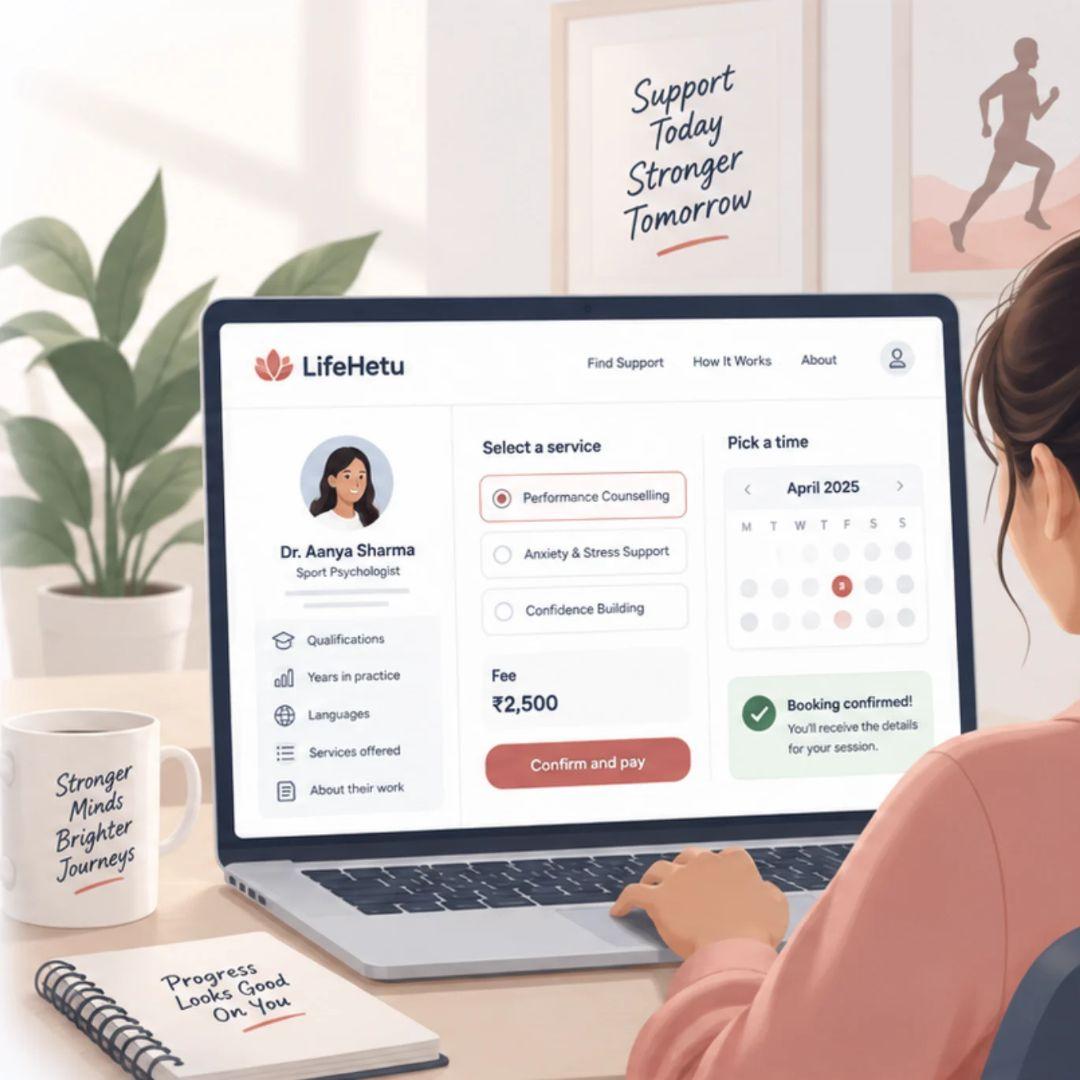
How Online Booking Through LifeHetu Works
Explore practitioners
Browse the professionals who offer couples and relationship counselling. Nothing is behind a sign-up.
Read the profile
Qualifications, years in practice, languages, the services they offer and how they describe their own work are on each profile.
Choose the service
Pick the relationship or couples counselling service that practitioner offers. The fee is shown for that service.
Pick a time
Availability comes live from the practitioner’s own calendar, so the times shown are the ones open.
Confirm and pay
One person completes the booking in their own name, and the session details come to them.
Privacy and Confidentiality When More Than One Person Is Involved
Confidentiality is an important part of counselling, but how it applies when more than one person is taking part depends on the practitioner’s professional approach, their ethical obligations and the circumstances. Those obligations also have recognised limits — for example where there is a risk of serious harm.
Practitioners differ on one question in particular: what happens to something one partner tells them individually. Some will hold it in confidence; some work on the basis that they will not keep secrets between partners; some agree an approach with both people at the start. None of these is unusual, and none of them is LifeHetu’s to decide. Ask the practitioner to explain how they handle confidentiality, and how they handle any individual conversations, before you rely on either.
How LifeHetu handles the data you give the platform is a separate matter from the practitioner’s professional confidentiality, and is covered in our privacy policy.
When Couples Counselling May Not Be the Right Immediate Step
Joint counselling assumes both people can speak freely and safely. Where there is violence, threats, intimidation or control in a relationship, that assumption does not hold — speaking openly in a session can have consequences afterwards, and better communication is not an answer to being harmed. In those situations, support for the person at risk, on their own, generally comes first, and a practitioner may tell you the same. Counselling booked through LifeHetu is also a scheduled conversation, not an emergency service, and it does not replace psychiatric assessment, medical care or legal advice where those are needed.
If anyone is in immediate danger, or if you are having thoughts of self-harm or suicide, go to the nearest hospital or emergency room, where you can see a psychiatrist, counsellor or therapist in person. Do not wait for a scheduled session. Involving a family member or friend who can be with you helps.
Online Sessions, and Meeting in Person Later
Sessions booked through LifeHetu are online. After connecting with a practitioner, you may discuss directly with them whether meeting in person could be an option in the future. Whether that is possible depends on the practitioner’s own location, availability and working arrangements — any such arrangement is between you and them, and is not arranged, scheduled or managed by LifeHetu.
Couples & Relationship Counselling Questions
It is a structured setting in which people can talk through concerns affecting a relationship, with a practitioner whose work includes relationship or couples counselling. It may involve both partners together, or one person talking through relationship concerns on their own. What happens depends on the practitioner’s training and approach and on the circumstances — there is no single method.
No. People come while married, while unmarried and living together, while in a long-distance relationship, while deciding whether to commit, and while working out whether to stay. It is also not only for relationships in crisis — wanting to understand a relationship more clearly is a reason people come.
Not necessarily, and many people do come alone. Some people come together and some speak with a practitioner on their own about a relationship — both are ordinary. How sessions are structured depends on the practitioner, the circumstances and what kind of support is being sought. Individual counselling about a relationship and couples counselling are not the same thing, though, and a practitioner may say one suits your situation better than the other. It is worth asking what they prefer before booking.
One person makes the booking, in their own name, and the session details go to that person. LifeHetu does not send a separate invitation to a second participant or hold a joint record for a couple. If you are both attending, agree between you how you will join, and tell the practitioner that two of you will be there.
Confidentiality is an important part of counselling, but how it applies when more than one person is taking part depends on the practitioner’s professional approach, their ethical obligations and the circumstances, and those obligations have recognised limits. Practitioners differ in particular on what happens to something one partner tells them individually — some hold it in confidence, some do not keep secrets between partners, some agree an approach at the start. Ask your practitioner to explain how they handle both. How LifeHetu handles the data you give the platform is covered separately in our privacy policy.
The number and frequency of sessions can vary depending on the people involved, what they want to explore and the practitioner’s approach. There is no set number, and anyone who gives you one without knowing your situation is guessing. You can discuss this with the practitioner.
Read a few profiles and compare qualifications, years in practice, the services they offer, how they describe their work, languages, the current fee and when they have time available. LifeHetu does not match you to a practitioner, rank practitioners or assess which one suits you — reviewing the profiles can help you decide who you would like to speak with.
Both are on the practitioner’s profile. Fees are set by each practitioner and differ between practitioners and between the services they offer, so the fee shown is the one for that practitioner’s relationship or couples counselling service. Availability is drawn live from their own calendar.
Sessions booked through LifeHetu are online. After connecting with a practitioner, you may discuss directly with them whether meeting in person could be an option in the future. Whether that is possible depends on the practitioner’s own location, availability and working arrangements, and any such arrangement is between you and them — LifeHetu does not currently manage in-person session booking.
Joint counselling assumes both people can speak freely and safely, and where there is violence, threats, intimidation or control that assumption does not hold — speaking openly in a session can have consequences afterwards, and better communication is not an answer to being harmed. Support for the person at risk, on their own, generally comes first, and a practitioner may tell you the same. If anyone is in immediate danger, go to the nearest hospital or emergency room rather than waiting for a scheduled session.
Sources & References
- American Psychological Association — Understanding psychotherapy and how it worksThat therapeutic approaches vary by practitioner training, and what a first session typically involves.
- American Association for Marriage and Family TherapyThe professional field concerned with couple and family therapy, and the standards practitioners in it work to.
- British Association for Counselling and Psychotherapy — Types of therapyThat counselling covers distinct modalities, and that couples work is one of several distinct approaches.
- World Health Organization — Violence against womenThat intimate partner violence and controlling behaviour are recognised patterns needing dedicated support rather than joint counselling.
- World Health Organization — Mental health: strengthening our responseThat mental health exists on a continuum and that psychological support is distinct from medical or psychiatric treatment.
- NIMHANS — National Institute of Mental Health and NeurosciencesIndian context for mental health services and where in-person clinical care is accessed.
Explore Couples & Relationship Counselling Practitioners
Review practitioner profiles, current fees and available online sessions through LifeHetu.