Founder, LifeHetu
Puneet Pandey is the founder of LifeHetu. He has worked alongside psychologists since 2022 while building the platform, helping practitioners grow their online presence with digital tools and care solutions.
14 Apr 26 11:57 am
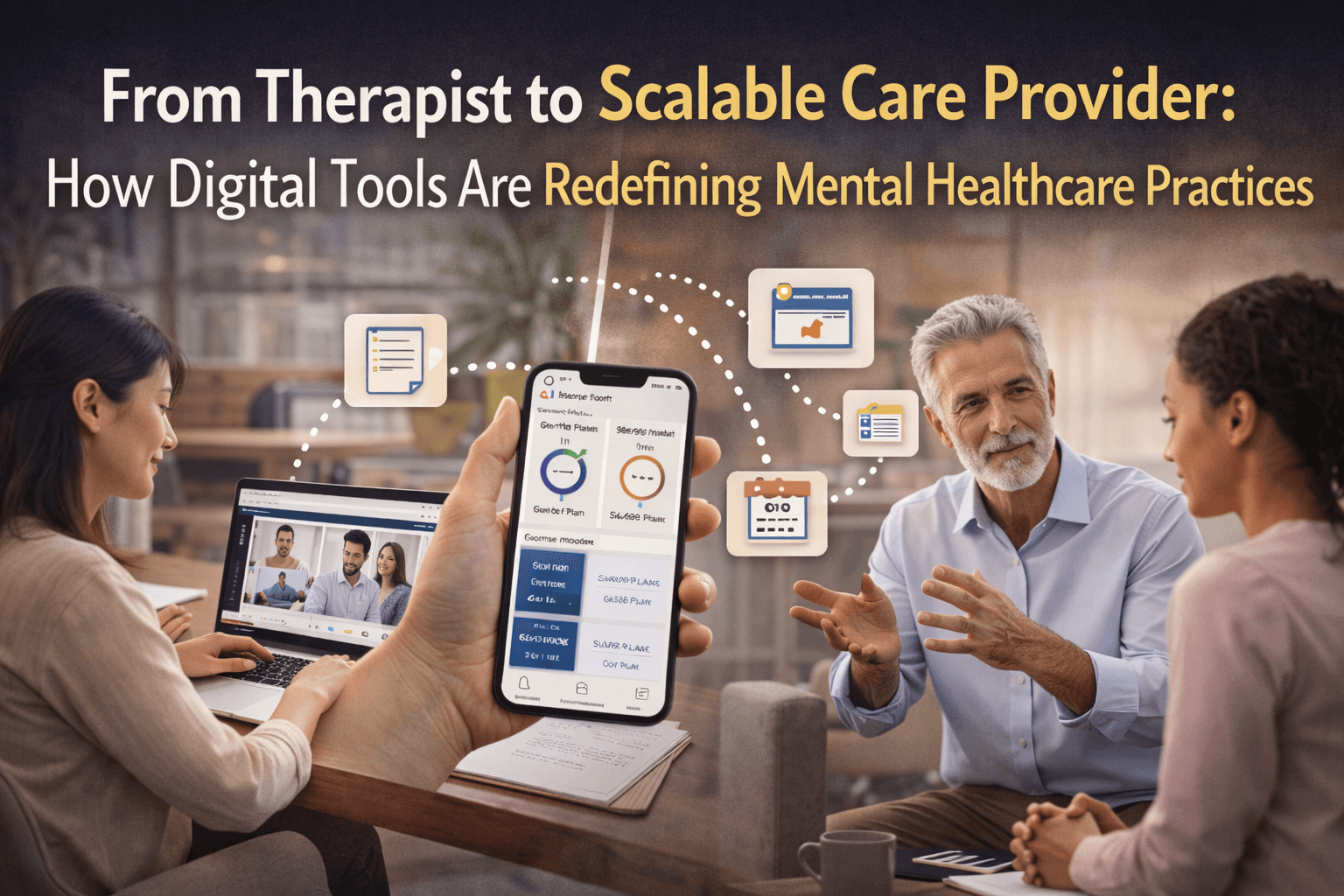
From Therapist to Scalable Care Provider: How Digital Tools Are Redefining Mental Healthcare Practices
Learn how therapists can scale their practice using digital tools, AI, and hybrid care models to increase income and impact without working more hours.
On this page
Jump to sections
Therapy Was Never Meant to Be Limited by Time For a long time, therapy followed a simple structure. One therapist. One client. One session at a time.
It’s personal, effective, and deeply meaningful. But it also comes with a limitation that most therapists eventually feel. There are only so many hours in a day.
And no matter how skilled or experienced you are, your impact and your income gets tied to how many sessions you can conduct.
This is where a quiet shift is happening. Therapists are no longer thinking only in terms of sessions.
They are starting to think in terms of systems. This is the shift from being just a practitioner to becoming a scalable care provider.
The Shift: From 1:1 Therapy to Scalable Care Models
The traditional 1:1 therapy model is still important. It will always have its place. But it is no longer the only way to deliver care.
Today, therapists are exploring ways to extend their support beyond one session at a time.
This includes:
- Structured care plans
- Self-paced courses
- Guided programs
- Private communities
These are not replacements for therapy. They are extensions of it.
For example, instead of repeating the same psychoeducation in every session, therapists can create structured content once and use it across multiple clients. Instead of limiting support to one hour per week, they can create touchpoints between sessions.
This changes the nature of care. It becomes more continuous, more accessible, and more scalable. And for clients, it often feels more supportive.
Why This Shift Matters for Mental Health Professionals

This shift is not just about scaling. It’s about sustainability.
Many mental health professionals eventually reach a point where they feel stretched. More clients mean more sessions, more notes, more coordination, and more emotional energy.
Growth starts to feel exhausting instead of exciting. Scalable models change that.
They allow you to:
- Serve more people without increasing hours
- Create structured journeys instead of repeating sessions
- Build predictable revenue streams
This is where mental health practice growth becomes more strategic instead of purely effort-driven.
The Role of AI: Reducing Work That Doesn’t Need Your Time
One of the biggest reasons this shift is becoming possible now is AI.
Not in the way people often fear but in a much more practical way.
AI is not replacing therapists.
It is removing the kind of work that doesn’t require human depth.
Think about:
- Writing session summaries
- Structuring notes
- Organizing client information
- Automating reminders
These tasks are necessary, but they don’t need your full attention. This is where AI in mental health becomes useful. It frees up time. And that time can be reinvested into what actually matters—client interaction, deeper thinking, and better care.
Scaling Without Burning Out
There’s a common misconception that scaling means doing more. More clients. More sessions. More effort. But in reality, scaling means doing things differently.
With the help of digital tools for therapists, you can start separating your time from your income.
For example:
- A recorded module can help multiple clients
- A structured activity can be reused
- A care plan can guide multiple journeys
This doesn’t reduce the quality of care. If done right, it improves consistency. Because instead of improvising everything in real time, you are delivering something that is already thoughtfully designed.
New Models That Are Emerging in Mental Healthcare
If you look at how therapy practices are evolving, you’ll notice new patterns.
Many therapists are moving toward hybrid and scalable models such as:
- Hybrid care models (combining online + offline therapy)
- Subscription-based support (monthly care instead of per session)
- Structured therapy programs
- Community-based support systems
These models allow therapists to create different levels of engagement. Some clients may need deep 1:1 sessions. Others may benefit from guided programs or regular check-ins. This flexibility creates both impact and stability.
The Real Challenge: Managing Everything Together
While all of this sounds promising, there is a practical challenge. How do you manage all of this without things becoming chaotic? Because now you’re not just handling sessions.
You’re handling:
- Multiple care formats
- Different types of clients
- Ongoing engagement
- Payments across models
This is where many therapists feel stuck. Not because they lack ideas, but because they lack the system to support those ideas.
Why Digital Platforms Are Becoming Essential
To truly move from a therapist to a scalable care provider, you need more than intent. You need infrastructure.
This is where mental health practice management software plays a critical role.
Instead of using separate tools for:
- Scheduling
- Payments
- Notes
- Engagement
You need a system that connects everything. Because scaling is not just about adding more offerings. It’s about managing them smoothly.
How LifeHetu Enables This Shift
This is exactly where LifeHetu CRM fits into the picture. It is not just a tool for managing sessions. It is designed to support the entire ecosystem of a modern therapy practice.
With LifeHetu, you can:
- Manage appointments across different formats (online, offline, hybrid)
- Accept payments for sessions, packages, or subscriptions
- Create structured care journeys through activities and plans
- Track client progress over time
- Engage clients beyond sessions
What this does is simple but powerful.
It gives you the ability to scale without losing control. Instead of juggling tools, you build a system. And that system allows you to grow both your impact and income at the same time.
The Future of Mental Healthcare Practices
The future of therapy is not about replacing human connection. It’s about extending it.
The therapists who will grow in the coming years are not necessarily the ones who work more hours. They are the ones who design better systems.
They understand that care does not have to be limited to a single session. It can be continuous, structured, and supported by the right tools. This is what defines a scalable mental healthcare practice.
Final Thoughts
The shift from therapist to scalable care provider is not about changing who you are. It’s about expanding how you deliver what you already do.
With the right approach and the right tools, you can:
- Reach more people
- Deliver better outcomes
- Create a more sustainable practice
And most importantly, you can do all of this without burning out. Because in the end, scaling is not about doing more work. It’s about building something that works better.
About the Author
Puneet is the founder of LifeHetu Technology, a platform built specifically for mental healthcare professionals to manage appointments, documentation, payments, and client engagement securely. He works closely with therapists, psychologists, and counselling centres to simplify digital practice management while preserving confidentiality and clinical integrity.
FAQs
What is a scalable mental healthcare practice?
A scalable mental healthcare practice allows therapists to serve more clients through structured systems like programs, care plans, and digital tools.Can therapists increase income without increasing sessions?
Yes. Using digital tools for therapists, you can create scalable offerings like courses and subscriptions.How does AI help therapists?
AI in mental health helps reduce admin work like notes, scheduling, and reminders, saving time.What are hybrid care models?
Hybrid care models combine online and offline therapy for better flexibility and continuity.How does LifeHetu help therapists scale?
LifeHetu CRM helps manage appointments, payments, client engagement, and care plans in one platform, enabling growth without complexity.
On this page
Jump to sections
About the author
Founder, LifeHetu
Puneet Pandey is the founder of LifeHetu. He has worked alongside psychologists since 2022 while building the platform, helping practitioners grow their online presence with digital tools and care solutions.
Related Reads. Similar Blogs to Check Out.