Digital Marketing Specialist
Shubham Srivastava is a digital marketing specialist with 3+ years of experience in the mental healthcare domain. He blends SEO expertise, social media strategy and creative storytelling to help mental health brands grow their digital presence.
25 Mar 26 08:06 am
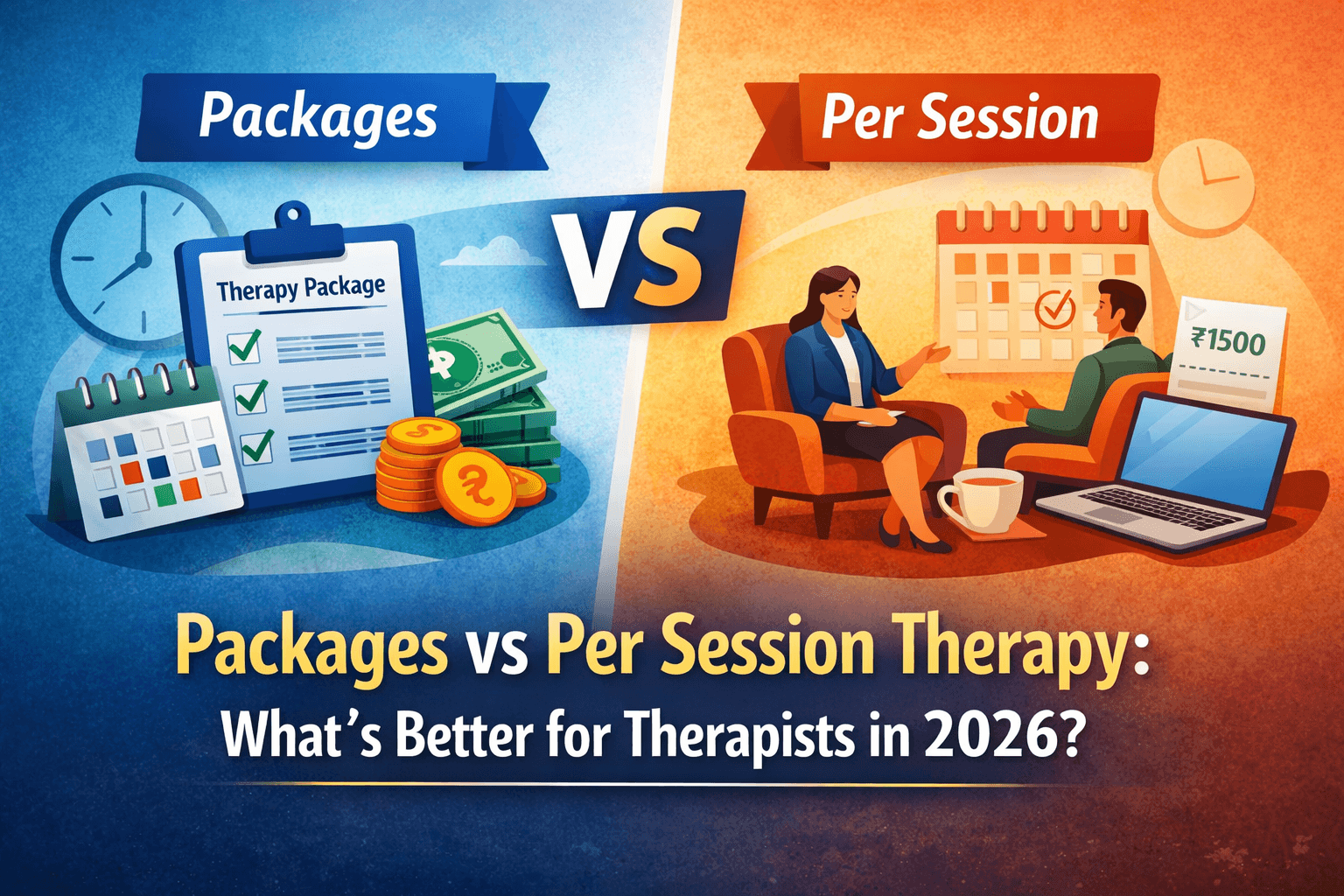
Packages vs Per Session What’s Better for Therapists in 2026
Confused between therapy packages and per-session pricing? Learn what works best for therapists in 2026 to improve client retention and grow your practice.
On this page
Jump to sections
Not every therapist struggles with getting clients. But almost every therapist struggles with how to charge them. And it’s not something people openly discuss. Some therapists quietly stick to per-session pricing because it feels safe. Others experiment with packages but feel unsure if they’re doing it right. And many are stuck somewhere in between, constantly second-guessing their decision.
What makes this even more confusing is that there is no clear “right answer.” What works for one therapist might not work for another. But at the same time, this decision has a direct impact on your income, client retention, and overall therapy practice growth.
Over time, I’ve noticed that this isn’t really a pricing problem. It’s a clarity problem. Once you understand how clients think, how they commit, and how therapy actually works over time, the answer becomes much simpler.
Let’s break it down in a way that actually helps you decide.
Why This Question Matters More in 2026
The world of ++online counselling++ has changed a lot. Clients today are not just looking for someone to talk to once. Many are looking for guidance, structure, and a sense of progress. They want to know what the process looks like, how long it might take, and whether they are moving toward something meaningful.
At the same time, people are also more cautious with money and more careful about where they commit. That means your pricing model has to do two things at once. It should feel easy enough for a new client to begin, but also strong enough to support long-term work.
This is exactly why the packages vs per session conversation is no longer just about convenience. It is about therapy practice growth, client retention, and the long-term health of your practice.
How Per-Session Pricing Works in Real Life
Let’s start with the model most therapists already know well: per-session pricing.
This approach is simple. A client books one session, pays for that one session, attends it, and then decides what to do next. It feels flexible for both sides. The client does not feel locked into a longer commitment, and the therapist does not need to explain a bigger structure right away.
That flexibility is the biggest reason why per-session therapy remains common. For a new client, especially someone who is unsure about therapy, this model can feel much less intimidating. It lowers the barrier to entry. A person can say yes to one session much more easily than they can say yes to a full care plan.
From a business point of view, though, this model has limits. Because there is no built-in commitment, clients can cancel more casually, postpone decisions, or disappear after one or two sessions. Even when they need more support, they may keep thinking about therapy one session at a time instead of seeing it as a process.
This creates unpredictability. One week feels full, the next week feels empty. Income becomes inconsistent, and the emotional energy required to keep re-engaging clients also increases. Many therapists who rely only on per-session pricing eventually feel like they are constantly starting over.
Why Therapy Packages Are Becoming More Relevant
Now let’s look at therapy packages.
A package usually means offering a set number of sessions together. This could be four sessions, six sessions, eight sessions, or even a more structured care plan depending on your practice. Sometimes clients pay upfront. Sometimes the package is split into installments. But the key difference is that the journey is defined from the beginning.
For many ++mental health professionals++, this model feels more intentional. It gives therapy a clear shape. Instead of asking the client to decide again after every session, it creates continuity from the start.
That continuity is powerful. Clients tend to show up more consistently when they already see themselves as part of a process. They engage more seriously, and they are less likely to drop off too early. This matters because therapy often works best with rhythm, reflection, and follow-through. Real change rarely happens in a single conversation.
From the therapist’s side, therapy packages create more stability. You can plan better, structure sessions more thoughtfully, and forecast income with more confidence. Instead of building your month one booking at a time, you begin to build a more predictable system.
That is one of the reasons packages are becoming more important in ++online therapy India++ and beyond. As more therapists move online and more clients expect convenience with clarity, structured support starts to feel more valuable.
The Real Difference Between Packages and Per Session
When people compare packages vs per session, they often focus only on money. But that is actually the shallowest part of the conversation.
The deeper difference is this: per-session pricing offers flexibility, while therapy packages create commitment.
Neither one is automatically better. They simply solve different problems.
If your goal is to make it easy for a new client to begin, per-session therapy can work very well. It feels less risky and less overwhelming. But if your goal is to encourage consistency, improve retention, and build a more stable practice, therapy packages often do a better job.
That is why the smartest answer is rarely “only this” or “only that.” In most cases, the better question is how each option fits into your client journey.
What Clients Actually Prefer
This is where many therapists make assumptions that are not always true.
Some believe clients only want flexibility. Others assume that people avoid packages because they do not want commitment. But in reality, many clients are not avoiding commitment — they are avoiding confusion.
When a client understands why a package exists, what it includes, and how it supports their progress, it often feels helpful rather than pushy. In fact, some people feel more comfortable when the path is clearly laid out. It reduces decision fatigue and gives them a sense of direction.
This is especially true for clients seeking ++mental health support++ for ongoing concerns like anxiety, burnout, relationship challenges, or emotional regulation. These are not one-session issues. When you position therapy as a journey instead of an isolated event, a package often makes more sense to the client too.
The mistake is not in offering a package. The mistake is offering it without context.
Why Packages Often Lead to Better Outcomes
This is something I think deserves more attention.
A lot of conversations about pricing stay stuck at revenue. But the bigger point is that therapy packages can improve outcomes, not just earnings.
When clients commit to multiple sessions, they are more likely to stay engaged long enough to experience change. They do not keep deciding from scratch after every session. They begin to see therapy as a process they are participating in, not just a service they are testing.
That mindset shift matters.
Consistency creates momentum. Momentum builds trust. And trust allows deeper work to happen. So while packages certainly support therapy practice growth, they also support better care when used in the right way.
That is why I do not see packages as only a business model. I see them as a care design decision.
Where Per Session Still Makes Sense
That said, per-session pricing is still valuable.
It works well for first-time clients who are hesitant about therapy. It can also work for consultations, one-time discussions, or clients who truly need a more flexible arrangement. In some cases, it becomes a good entry point for building trust before suggesting a longer plan.
And that is important, because not every client is ready to commit at the start. Some need one good experience before they can say yes to more.
So the goal should not be to replace per-session therapy completely. The goal should be to use it strategically.
Think of it like this: per session helps people begin, while packages help them continue.
The Smartest Model for Most Therapists
From what I have seen, the most practical and effective model for 2026 is a hybrid one.
Start with a per-session therapy option so that new clients feel comfortable entering your world. Make that first step simple and low-pressure. Then, once they have experienced a session and understand the value of your work, guide them toward a more structured package if it makes sense for their needs.
This approach gives you the best of both worlds. It respects the client’s need for flexibility while also making room for consistency and better outcomes.
For therapists building their presence in online counselling, this model is especially useful. The internet creates convenience, but it also creates distraction. People can drop off easily if there is no structure. A hybrid model helps reduce that drop-off without making the first step feel heavy.
So, What’s Better for Therapists in 2026?
If I had to answer the question directly, I would say this: therapy packages are better for long-term practice growth, but per-session pricing still plays an important role in helping clients start.
So the real answer is not one versus the other. The real answer is knowing when to use each one.
If your practice only offers per session, you may stay stuck in inconsistency. If your practice only offers packages, you may create too much friction at the beginning. But if you combine the two thoughtfully, you create a system that feels both welcoming and sustainable.
That is what more ++mental health professionals++ need in 2026, not a rigid rule, but a pricing model that matches how clients actually behave.
Final Thoughts
Pricing is never just about numbers. In a therapy practice, it reflects how you think about care, commitment, and growth.
If you only think of pricing as a transaction, you will probably choose the model that feels easiest to explain. But if you think about it as part of the client journey, your decision becomes much stronger.
A new client often needs the freedom of a first step. That is where per-session therapy works beautifully. But meaningful progress usually needs continuity, and that is where therapy packages become powerful.
So instead of asking whether packages or per session is universally better, ask a more useful question: what kind of experience do I want my clients to have, and what kind of practice do I want to build?
When you answer that honestly, the right pricing model becomes much easier to see.
And for most therapists in 2026, the answer will not be choosing one side. It will be learning how to use both in a smarter way.
About the Author
Shubham is a Digital Marketing and Content Specialist at LifeHetu Technology. For over three years, he has worked closely with therapists, psychologists, and counselling centres to help them build a strong and ethical online presence. Through his work with mental healthcare providers, he understands the unique challenges of communicating sensitive services responsibly while reaching the people who need support. His focus lies in bridging the gap between mental healthcare demand and supply through thoughtful digital strategy and content.
FAQs
Are therapy packages better than per-session therapy?
For long-term care and better retention, therapy packages are usually stronger. For first-time clients who need flexibility, per-session therapy can work welDo clients prefer packages vs per session?
It depends on how the options are explained. Many clients appreciate therapy packages when they understand the structure and purpose behind them.Is per-session pricing bad for therapists?
Not at all. Per-session pricing is useful, especially as an entry point. The challenge begins when it is the only model used for every kind of client.Why are therapy packages good for therapy practice growth?
They improve consistency, reduce drop-offs, and create more predictable income, which supports stronger therapy practice growth over time.What is the best pricing model for online therapy India in 2026?
A hybrid approach often works best for online therapy India, starting with per-session therapy and then offering therapy packages for clients who need ongoing support.
On this page
Jump to sections
About the author
Digital Marketing Specialist
Shubham Srivastava is a digital marketing specialist with 3+ years of experience in the mental healthcare domain. He blends SEO expertise, social media strategy and creative storytelling to help mental health brands grow their digital presence.
Related Reads. Similar Blogs to Check Out.