Stress & Burnout: Signs, Differences and Support Options
Stress is a normal response to challenging situations, and experiencing it does not mean something is wrong with you. Prolonged or overwhelming stress can still affect wellbeing and everyday functioning — and burnout has a more specific, occupational meaning than everyday use suggests.
This page explains what stress is, what the World Health Organization actually means by burn-out, how the two differ from each other and from anxiety and depression, when professional support may be worth considering, and how to explore practitioners and book an available online session through LifeHetu. It is general information, not an assessment of you.

What Is Stress?
The World Health Organization defines stress as a state of worry or mental tension caused by a difficult situation. It describes stress as a natural human response that prompts us to address challenges and threats, and notes that everyone experiences it to some degree.
It is not automatically a problem. The WHO is explicit that a little stress is good and can help us perform daily activities — what makes the difference to wellbeing is how much of it there is, how long it lasts and how a person is able to respond. Feeling stressed before an exam, a deadline, an interview, a medical appointment or a difficult conversation is the response doing what it exists to do.
Stress is also not one experience. The WHO notes that people react differently to stressful situations, and that coping styles and symptoms vary from person to person. Two people under the same pressure can look nothing alike.
Nothing on this page is a mental health diagnosis, and experiencing stress does not by itself mean a person has a mental health condition.
When Can Stress Start Affecting Wellbeing?
There is no threshold at which ordinary stress becomes something else, and no symptom count that settles it. What tends to matter is how sustained it is and how far it is reaching into the rest of life.
It has gone on for a long time, or keeps returning
It feels overwhelming rather than demanding
Rest does not seem to restore much
Sleep is disrupted, or concentration is noticeably harder
Work, study or everyday responsibilities are becoming difficult to manage
Relationships are being affected
Coping has started to involve more alcohol, tobacco or other substances
It continues even after the situation that caused it has changed
The WHO puts it carefully: most of us manage stress well and continue to function, and if we have difficulty coping we should seek help from a trusted health-care provider or another trusted person. It also notes that chronic stress can worsen pre-existing health problems and may increase use of alcohol, tobacco and other substances, and that stressful situations can cause or worsen mental health conditions — most commonly anxiety and depression — which need access to health care. None of that is a rule you can apply to yourself; it is a reason to talk to someone if you are unsure.
What Is Burnout?
Burn-out is included in ICD-11, the World Health Organization’s International Classification of Diseases, as an occupational phenomenon. The WHO states plainly that it is not classified as a medical condition. It appears in a chapter called "Factors influencing health status or contact with health services" — reasons people come into contact with health services that are not themselves classed as illnesses or health conditions.
ICD-11 defines it as a syndrome conceptualised as resulting from chronic workplace stress that has not been successfully managed. That phrase does a lot of work: it locates burn-out in the relationship between a person and sustained conditions at work, not in a diagnosis a person carries.
The three dimensions in the WHO definition
- Feelings of energy depletion or exhaustion
- Increased mental distance from one’s job, or feelings of negativism or cynicism related to one’s job
- Reduced professional efficacy
These are the three dimensions as the WHO states them, and they are reproduced here rather than expanded. They are not a checklist, there is no score, and recognising something of yourself in them does not establish that you have burn-out — that is a judgement for a qualified professional who can ask about the whole situation.
The formal definition is specifically about work
The WHO is unusually direct on this point: burn-out "refers specifically to phenomena in the occupational context and should not be applied to describe experiences in other areas of life". That is part of the definition, not a footnote to it.
In everyday conversation people say burnout far more broadly — parenting burnout, caregiver burnout, relationship burnout, student burnout, social burnout. Those experiences are real, and exhaustion from sustained demands outside paid work is worth taking seriously. But they are not the ICD-11 construct, and treating them as though they were creates diagnostic categories that do not exist. This page uses "burn-out" in the WHO sense and says so when it means something broader.
Exhaustion is not automatically burnout
Being tired, needing a holiday, disliking your job, or losing motivation for a week or two is not the same as burn-out, and nothing here should be read as saying it is. Persistent exhaustion in particular has many possible explanations — sleep, physical health, medication, a mental health condition, sustained workload, or several at once — and assuming one before it has been established is how people end up managing the wrong thing.
You will also find "stages of burnout" models widely circulated online — honeymoon phase, onset of stress, chronic stress, burnout, habitual burnout. These are popular frameworks rather than part of the WHO definition or any classification system, and this page does not present them as fact.
Stress and Burnout Are Not the Same
They are related — the WHO definition of burn-out is built on chronic workplace stress — but they are different ideas, and the difference matters to what might help.
| Stress | Burn-out (WHO / ICD-11) |
|---|---|
A natural human response to demands, challenges or difficult situations. | A syndrome conceptualised as resulting from chronic workplace stress that has not been successfully managed. |
Can arise anywhere in life — work, study, relationships, money, caregiving, health, uncertainty. | Refers specifically to the occupational context, and the WHO says it should not be applied to other areas of life. |
May be brief and manageable, or prolonged and overwhelming. | Characterised by three dimensions: exhaustion, mental distance or cynicism towards the job, and reduced professional efficacy. |
Not a disorder in itself, though prolonged stress can contribute to mental health conditions. | Explicitly not classified by the WHO as a medical condition. |
This is an orientation, not a diagnostic comparison, and reading across the columns will not tell you which applies to you. Prolonged stress does not inevitably lead to burn-out, and plenty of people experience significant work stress without it.
How Can Prolonged Stress Show Up?
The WHO notes that stress makes it hard to relax and can come with a range of emotions including anxiety and irritability. People describe it differently, and no one has all of the following.
Thoughts and emotions
Finding it difficult to relax or switch off
Worry that keeps returning
Irritability, or a shorter fuse than usual
Difficulty concentrating
Struggling to make decisions
Feeling overwhelmed
Physical experiences
Headaches, or other body pains
Muscle tension
An upset stomach
Trouble sleeping
Losing your appetite, or eating more than usual
Tiredness
Behaviour
Withdrawing from people
Sleeping or eating much more, or much less, than usual
Avoiding certain places or situations
Finding usual responsibilities harder to complete
Drinking, smoking or using other substances more than before
Every one of these can have causes other than stress. This is a description of how stress can present, not a list to count — and the WHO’s own point stands: stress is not always easy to recognise as the reason someone is feeling or behaving differently, which is part of why talking it through with someone can help.
Can Burnout Look Like Depression or Anxiety?
Some experiences overlap, which is exactly why this is worth setting out rather than leaving to the reader.
Exhaustion, reduced motivation, difficulty concentrating, disrupted sleep and feeling low can all appear in work-related burn-out and in a depressive disorder. Looking similar from the outside is not the same as being the same thing.
Burn-out and depression
Burn-out, in the WHO sense, is an occupational phenomenon and is not classified as a medical condition. Depression is a recognised mental disorder that the WHO describes as involving a depressed mood or loss of pleasure or interest in activities for long periods, affecting all aspects of life rather than work specifically. Someone whose difficulties extend well beyond work, or whose symptoms persist when work changes, may be experiencing something that needs assessment.
Read about depressionStress and anxiety
Stress is a response to demands and difficult situations, and the WHO notes that anxiety is among the emotions it can come with. Anxiety disorders are something more specific — recognised conditions defined by particular patterns of fear or anxiety together with related symptoms and behaviour, assessed against criteria by a qualified professional. Feeling anxious under pressure is not the same as having an anxiety disorder, and the two are not interchangeable.
Read about anxietyThe WHO notes that stressful situations can cause or exacerbate mental health conditions, most commonly anxiety and depression, and that these require access to health care. Working out which of these is in play is a professional assessment, not something a page can do or that a reader should try to settle alone.
What Can Contribute to Stress or Burnout?
Stress can come from anywhere. The WHO notes it is natural to feel stressed in situations such as job interviews, exams, unrealistic workloads, an insecure job, or conflict with family, friends or colleagues — and that it tends to be widespread during events such as economic crises, disease outbreaks, disasters and conflict.
Work demands
Excessive workload or pace, understaffing, long or inflexible hours, unclear job role, and job insecurity are among the workplace risks the WHO identifies. In the ICD-11 definition, sustained workplace stress is what burn-out is built on.
Lack of control
Little say over how work is designed or how much of it there is. The WHO lists lack of control over job design or workload among psychosocial risks to mental health at work.
Relationships and conflict
Conflict with family, friends or colleagues, limited support from colleagues, authoritarian supervision, and at the serious end violence, harassment or bullying.
Money and security
Financial pressure, inadequate pay, insecure work, or recent job loss. The WHO notes that being out of work is itself a risk to mental health.
Caring and competing demands
Conflicting home and work demands, caregiving responsibilities, or several obligations that cannot all be met at once. This is stress; it is outside what the WHO burn-out definition covers.
Health, uncertainty and change
A health problem, a major life change, or a stretch of not knowing what happens next. Uncertainty is demanding even when nothing has gone wrong yet.
Not enough recovery
Sustained demand without breaks, rest or time genuinely away from it. Lack of recovery is often what turns manageable pressure into something that accumulates.
Nothing here can tell you what is contributing to your own situation, and several of these usually act together rather than one alone. Note also that the formal burn-out concept stays tied to the occupational context — sustained strain from caregiving or study is real, but calling all of it burnout blurs a distinction the WHO deliberately drew.
Workplace Conditions Are Part of the Picture
It is easy to read a page like this as saying that if you managed stress better, the problem would go away. That is not what the evidence supports, and it is worth saying plainly.
The World Health Organization describes risks to mental health at work — psychosocial risks — as including excessive workloads or work pace, understaffing, long or unsocial or inflexible hours, lack of control over job design or workload, unsafe or poor physical working conditions, an organisational culture that enables negative behaviours, limited support from colleagues or authoritarian supervision, violence, harassment or bullying, discrimination and exclusion, an unclear job role, under- or over-promotion, job insecurity or inadequate pay, and conflicting home and work demands.
Its recommendation for preventing work-related mental health conditions is organisational: the WHO recommends that employers implement interventions that directly target working conditions and environments — assessing and then mitigating, modifying or removing workplace risks — alongside manager training, mental health literacy for workers, and support for individuals. Individual coping is one part of a larger picture, not the whole of it.
Counselling can be a genuinely useful place to think about work, what is within your control and what to do about the rest. What it cannot do is fix an understaffed team or an unmanageable workload, and no one should be left feeling that their difficulty coping with those conditions is a personal failing.
When Physical Symptoms Need Medical Assessment
Headaches, muscle tension, stomach problems, disturbed sleep, appetite changes, tiredness, chest pain and a faster heartbeat all appear on the NHS list of stress symptoms. Every one of them also occurs in physical health conditions, as medication side effects, and for other reasons entirely — and stress is not always easy to identify as the cause even when it is one.
New, severe, persistent, unexplained or worsening physical symptoms deserve medical assessment rather than being put down to stress. Chest pain, severe breathlessness, fainting or sudden neurological symptoms need urgent medical attention, whatever you think the cause may be. Persistent unexplained exhaustion is worth having looked at rather than assumed.
When Might It Help to Speak With a Professional?
You do not have to be at a breaking point, and there is no threshold to cross first. People often find it useful in situations like these.
Stress is feeling difficult to manage, or has been going on a long time
Sleep or concentration is noticeably affected
Work, study or relationships are being disrupted
You feel persistently overwhelmed
The ways you are coping are starting to cause problems of their own
It continues even after the situation that caused it has changed
You are not sure whether this is stress, burn-out, anxiety, depression or something else
You simply want a place to think it through with someone outside it
That last one is not a lesser reason. The WHO’s own guidance is to seek help from a trusted health-care provider or another trusted person if you are finding it hard to cope, and working out what you are dealing with is part of what a professional conversation is for rather than something to establish beforehand.
What Can You Explore in Counselling?
What a session involves depends on the practitioner, their professional background and the approach they work with. Broadly, counselling offers a structured space to think about things it is hard to think about alone.
What is actually going on
Naming the sources of pressure, and separating what is one thing from what is several at once.
How you are responding
The emotional side of it, and the patterns of thinking and behaviour that have built up around it.
Boundaries and expectations
What you are carrying, what you have agreed to, and what is being assumed of you.
Work difficulties
What is happening at work, what is within your influence, and what options exist — including the ones outside your control.
Relationships
How the pressure is affecting the people around you, and how they are affecting it.
Coping
What you are doing now, what it is costing, and what else there might be.
Priorities and change
What matters most to you at the moment, and which changes are genuinely possible.
Not every practitioner works this way or with these things. LifeHetu does not deliver counselling, does not decide the approach, and does not build anyone a stress management plan — that is the practitioner’s work, and each profile describes how they practise where they have provided it.
Counselling is not coaching
Mental health counselling, executive coaching, career coaching, productivity coaching and organisational consulting are different things with different scopes and different training behind them. Adult Counselling through LifeHetu is counselling. It is not workplace coaching or business consulting, and this page does not present it as either. If what you are looking for is career direction rather than emotional support, Career Counselling is a separate service.
Everyday Strategies That May Help With Stress
The World Health Organization publishes practical suggestions for coping with stress. They are offered here as they are offered there — as things that may help, not as a prescription and not as a substitute for professional support where that is needed.
Some routine
The WHO suggests a daily schedule can help you use time and feel more in control — regular meals, time with people, activity, chores, and something that is not a task.
Sleep
Consistent times, a quiet and comfortable space, and less screen use before bed are the WHO’s suggestions for sleep habits.
Connection
Keeping in touch with family and friends, and sharing concerns with people you trust. The WHO notes this can lift mood and reduce how stressed you feel.
Movement
Regular daily activity — the WHO includes walking as well as more intensive exercise. What is appropriate depends on your own health circumstances.
Eating regularly
A balanced diet at regular intervals, and enough fluids.
Limits on the flow of news
The WHO suggests limiting time spent following news on television and social media where it increases stress. That is a judgement about what is affecting you, not a screen-time rule.
A few things this list is not. It is not treatment for anything, and none of it is a substitute for professional care where that is needed. It is not a set of rules with numbers attached — no minimum minutes of meditation, no water target, no break schedule, no fixed caffeine cut-off. And it is not a standard to be judged against: when stress is affecting sleep, appetite and motivation, difficulty keeping these up is part of what is happening rather than a failure of discipline.
On relaxation, breathing and mindfulness
Some people find relaxation practices, breathing exercises or mindfulness useful, and the WHO publishes a self-help stress management guide built on practical coping skills. They are worth trying if they appeal. They are not a cure for stress, they do not "reset" or "regulate" anything, and no brief practice reverses burn-out — that framing is wellness marketing rather than clinical description, and it sets people up to feel they have failed at something simple.
What LifeHetu Does, and What It Does Not
LifeHetu is a technology platform. It lists independent practitioners, publishes their professional profiles, and enables online session booking and payment. The practitioners listed are not employed by LifeHetu, and the professional relationship in a session is between you and the practitioner.
LifeHetu does not assess stress or burn-out, diagnose anything, provide counselling, design stress management plans, teach techniques, deliver workplace coaching, clinically match anyone to a practitioner, or monitor anyone’s progress. It does not certify anyone as a stress or burnout specialist. Where this page describes what counselling can involve, it is describing what practitioners do — not what LifeHetu does.
The purpose of support here is wellbeing and everyday functioning. It is not a route to working harder, producing more or performing better, and nothing on this page promises an improvement in any of those.
Where to Find Professional Support
LifeHetu lists independent practitioners and lets you book an online session with one of them. It does not maintain a list of stress or burnout specialists — practitioner records carry the services someone offers, not verified areas of specialism, so any such list would be guesswork. What you can do is read profiles and judge for yourself.
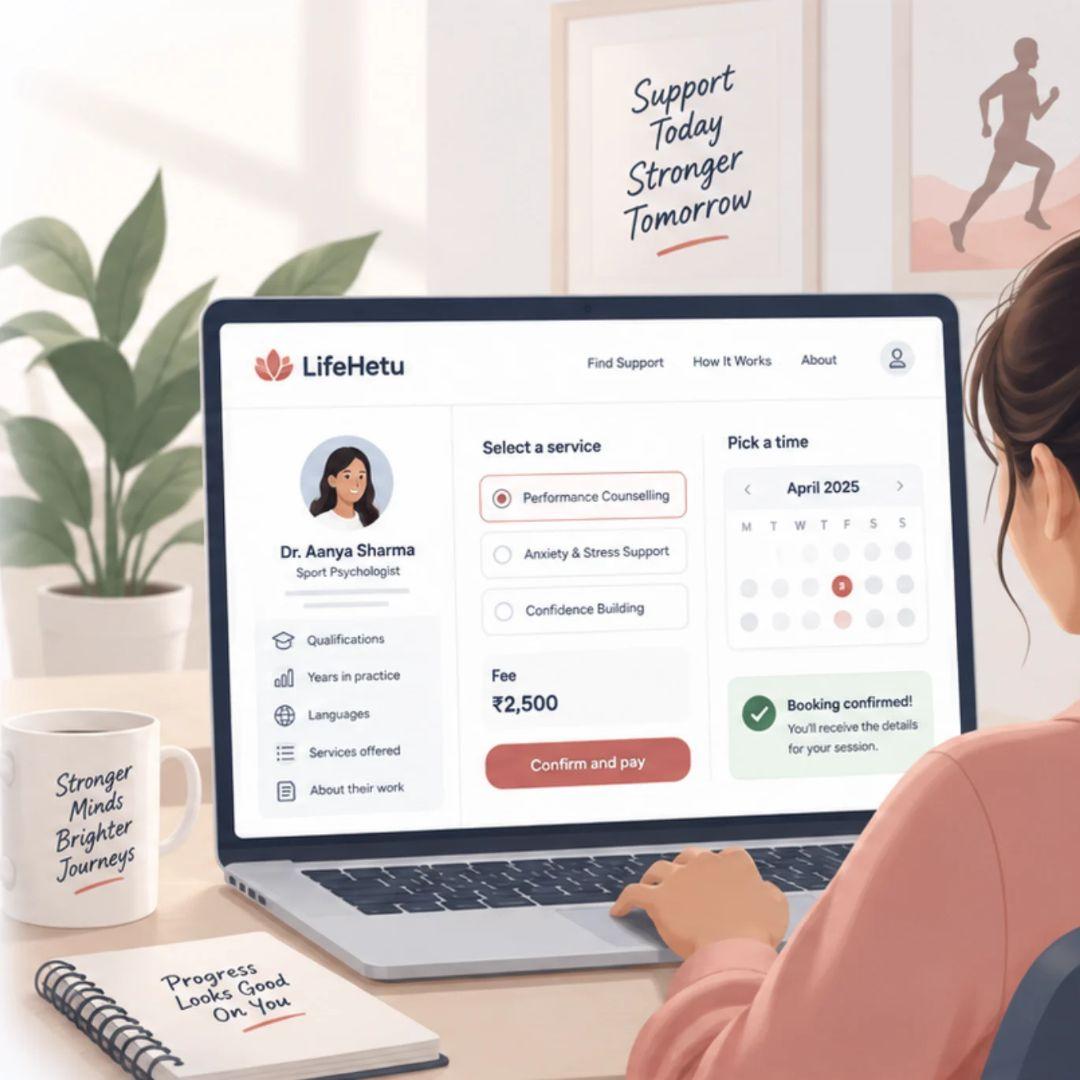
How Online Booking Through LifeHetu Works
Explore practitioners
Browse who is listed, with search and filters. Nothing is behind a sign-up.
Read the profile
Qualifications, years in practice, languages, the services they offer and how they describe their own work are on each profile.
Choose the service
Pick the service you want from the ones that practitioner offers. The current fee is shown for it.
Pick a time
Availability comes live from the practitioner’s own calendar at the moment you book, so the times shown are the ones actually open.
Confirm and pay
Complete the booking, and you receive the details for your session.
Sessions Are Booked Online
Sessions booked through LifeHetu are online. After connecting with a practitioner, you may discuss directly whether an in-person session could be an option in the future. Any such arrangement depends on the practitioner and is not managed by LifeHetu.
If You Need Urgent Support
Booking a session through LifeHetu is a scheduled conversation with a practitioner at a future time. It is not an emergency service, and it is not the right route for something that needs help now.
If you are having thoughts of self-harm or suicide, or someone is in immediate danger, go to the nearest hospital or emergency room, where you can see a psychiatrist, counsellor or therapist in person. Do not wait for a scheduled session. Involving a family member or friend who can be with you helps.
For severe physical symptoms — chest pain, severe breathlessness, fainting or sudden neurological symptoms — urgent medical care is the right first step, whatever you think the cause may be.
Related Pages
Questions About Stress and Burnout
The World Health Organization defines stress as a state of worry or mental tension caused by a difficult situation. It describes stress as a natural human response that prompts us to address challenges and threats, and notes that everyone experiences it to some degree. The WHO also notes that a little stress is good and can help us perform daily activities — what matters to wellbeing is how much there is, how long it lasts and how a person is able to respond.
No. Stress is a normal human response, not a diagnosis, and experiencing it does not mean someone has a mental health condition. The WHO does note that too much stress can cause physical and mental health problems, that chronic stress can worsen pre-existing health problems, and that stressful situations can cause or exacerbate mental health conditions — most commonly anxiety and depression — which require access to health care. That is a reason to speak to someone if stress is affecting you, not a reason to treat ordinary stress as an illness.
Burn-out is not a mental illness and not a medical condition. The World Health Organization includes it in ICD-11 as an occupational phenomenon, in a chapter covering factors that influence health status or bring people into contact with health services but that are not classed as illnesses or health conditions, and states plainly that it is not classified as a medical condition. ICD-11 defines it as a syndrome conceptualised as resulting from chronic workplace stress that has not been successfully managed, characterised by three dimensions: feelings of energy depletion or exhaustion; increased mental distance from one’s job, or feelings of negativism or cynicism related to one’s job; and reduced professional efficacy. Those three dimensions are the definition, not a checklist to score yourself against, and burn-out is not a psychiatric disorder, an anxiety disorder or a depressive disorder.
Stress is a broad, normal response to demands and difficult situations and can arise anywhere in life. Burn-out, in the WHO’s formal sense, is specifically about chronic workplace stress that has not been successfully managed, and is characterised by exhaustion, mental distance or cynicism towards the job, and reduced professional efficacy. Stress is not a disorder; burn-out is explicitly not classified as a medical condition. Prolonged stress does not inevitably lead to burn-out.
In the formal definition, yes. The WHO states that burn-out "refers specifically to phenomena in the occupational context and should not be applied to describe experiences in other areas of life". People do use the word far more broadly in everyday conversation — parenting burnout, caregiver burnout, student burnout — and the exhaustion those describe is real and worth taking seriously. But those broader uses are not the ICD-11 concept, and treating them as though they were creates categories that do not exist.
The WHO notes that stress makes it hard to relax and can come with emotions including anxiety and irritability, that it can make concentration difficult, and that it may involve headaches or other body pains, an upset stomach, trouble sleeping, and eating either less or more than usual. It also notes that chronic stress can worsen pre-existing health problems and may increase use of alcohol, tobacco and other substances. People respond differently, and none of these establishes that stress is the cause in any individual case.
They can look similar — exhaustion, reduced motivation, difficulty concentrating, disrupted sleep and low mood appear in both. But burn-out is an occupational phenomenon that the WHO does not classify as a medical condition, while depression is a recognised mental disorder involving a depressed mood or loss of pleasure or interest in activities for long periods, affecting all aspects of life rather than work specifically. Difficulties that extend well beyond work, or that persist when work changes, are worth having assessed. This is a professional judgement, not something to settle from an FAQ.
They overlap but are not the same. Stress is a response to demands and difficult situations, and the WHO notes anxiety is among the emotions that can come with it. Anxiety disorders are recognised conditions defined by particular patterns of fear or anxiety along with related symptoms and behaviour, assessed by a qualified professional. Feeling anxious under pressure is not the same as having an anxiety disorder.
Yes. Headaches, muscle tension, stomach problems, disturbed sleep, tiredness, chest pain and a faster heartbeat all appear on the NHS list of stress symptoms, and every one of them also occurs in physical health conditions, as a medication side effect, or for other reasons. New, severe, persistent, unexplained or worsening symptoms deserve medical assessment rather than being attributed to stress, and persistent unexplained exhaustion is worth having looked at. Chest pain, severe breathlessness, fainting or sudden neurological symptoms need urgent medical attention.
There is no threshold you have to cross first. People often find it useful when stress feels difficult to manage or has gone on a long time, when sleep or concentration is noticeably affected, when work or relationships are being disrupted, when they feel persistently overwhelmed, when the ways they are coping are causing problems of their own, when it continues after the situation has changed, or when they are simply unsure what they are dealing with. The WHO’s guidance is to seek help from a trusted health-care provider or another trusted person if you are finding it hard to cope.
Counselling can offer a structured space to think about what is happening, how you are responding, what is within your influence and what options exist. What a session involves depends on the practitioner and their professional background — LifeHetu does not deliver counselling, decide the approach or build anyone a stress management plan. It is also worth being clear that counselling is not workplace or executive coaching, and that individual support does not change working conditions: the WHO’s own recommendation for preventing work-related mental health problems is that employers act on those conditions directly.
There is no universal number. It depends on what you are dealing with, how long it has been going on, what else is happening in your life, the approach used, and your own circumstances. Anyone who gives you a figure before meeting you is guessing.
Yes. LifeHetu lists independent practitioners and enables online session booking; practitioners offering Adult Counselling are listed on this page with their current fees. After connecting with a practitioner you may discuss with them whether meeting in person could be an option in future; any such arrangement is between you and them and is not managed by LifeHetu.
Sources & References
- World Health Organization — Stress (questions and answers)The definition of stress as a state of worry or mental tension caused by a difficult situation; that it is a natural human response and everyone experiences it; that a little stress is good and helps us perform daily activities; that people respond differently; the signs described; that chronic stress can worsen pre-existing health problems and may increase substance use; that stressful situations can cause or exacerbate anxiety and depression; and the everyday coping suggestions.
- World Health Organization — Burn-out an "occupational phenomenon": ICD-11That burn-out is included in ICD-11 as an occupational phenomenon and is not classified as a medical condition; that it sits under "Factors influencing health status or contact with health services"; the full ICD-11 definition and its three dimensions; and that it refers specifically to the occupational context and should not be applied to other areas of life.
- World Health Organization — Mental health at workThe psychosocial risks to mental health at work listed, and that the WHO recommends employers implement organisational interventions that directly target working conditions and environments.
- World Health Organization — ICD-11 classificationWhere burn-out sits in the classification relative to mental, behavioural and neurodevelopmental disorders.
- World Health Organization — Depressive disorder (depression)The description of depression used in the burn-out comparison, including that it affects all aspects of life.
- World Health Organization — Anxiety disordersThe description of anxiety disorders used in the stress comparison.
- NHS — Get help with stressThe physical, mental and behavioural symptoms listed; that stress is not always easy to recognise as the reason someone feels or acts differently; and that some people find stress helpful or motivating.
- NIMHANS — National Institute of Mental Health and NeurosciencesIndian context for mental health services and where in-person clinical care is accessed.
Explore Practitioners Offering Adult Counselling
Stress and work-related difficulties are among many concerns people may choose to discuss in counselling. The practitioners below currently offer Adult Counselling through LifeHetu. Review each practitioner’s professional background, qualifications and listed services before deciding who you would like to speak with.
This list is based on who currently offers Adult Counselling, not on any assessment of expertise in stress or burnout. LifeHetu does not certify anyone as a stress or burnout specialist, does not rank practitioners and does not match you to one. Adult Counselling is counselling rather than workplace or executive coaching, and professional scope differs between practitioners, so read the full profile.
9 practitioners offering Adult Counselling

Mr Abhishek Faria
6 years in practice
Doctoral Candidate at California Southern University
Online session: Video · Phone Call · Chat
Languages: English, Hindi, Marathi, Gujarati
Fee: ₹1800 per session

Ms Priya Parwani
6 years in practice
Bachelor's in Psychology Master's in Psychology PG Diploma in Counselling Psychology
Online session: Video
Languages: English, Hindi
Fee: ₹1000 per session
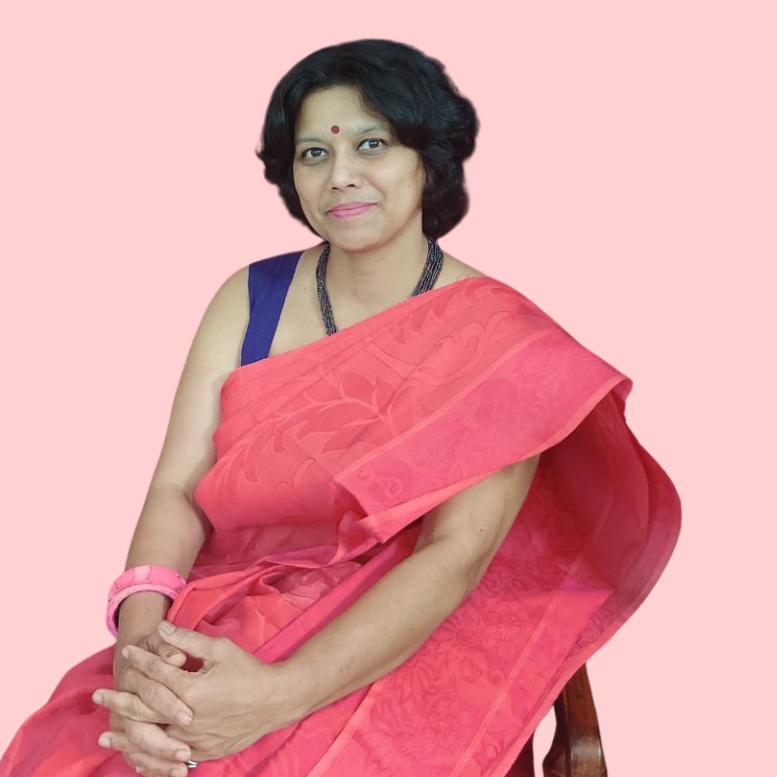
Mrs Mahalakshmi Rajagopal
28 years in practice
MSW, MSc
Online session: Video
Languages: English, Hindi, Tamil, Kannada, Telugu, Malayalam
Fee: ₹1800 per session

Ms Sonali Sikdar
16 years in practice
Online session: Video
Languages: English, Hindi, Marathi
Fee: ₹1500 per session

Dr. S.S. Saini
10 years in practice
M.Phil (Clinical Psychology), Ph.D (Clinical Psychology),PGDCBM with 10 years experience
Online session: Video · Phone Call
Languages: English, Hindi, Punjabi
Fee: ₹1500 per session

Dr Jignesh Ahir
11 years in practice
Masters in Applied Psychology, M.Phil. Ph.D in Psychology Research Gold Medalist
Online session: Video · Call · Chat
Languages: English, Hindi, Gujrati
Fee: ₹2000 per session

Ms Parinaaz Irani
8 years in practice
Online session: Video
Languages: English, Hindi, Marathi, Gujarati
Fee: ₹1500 per session
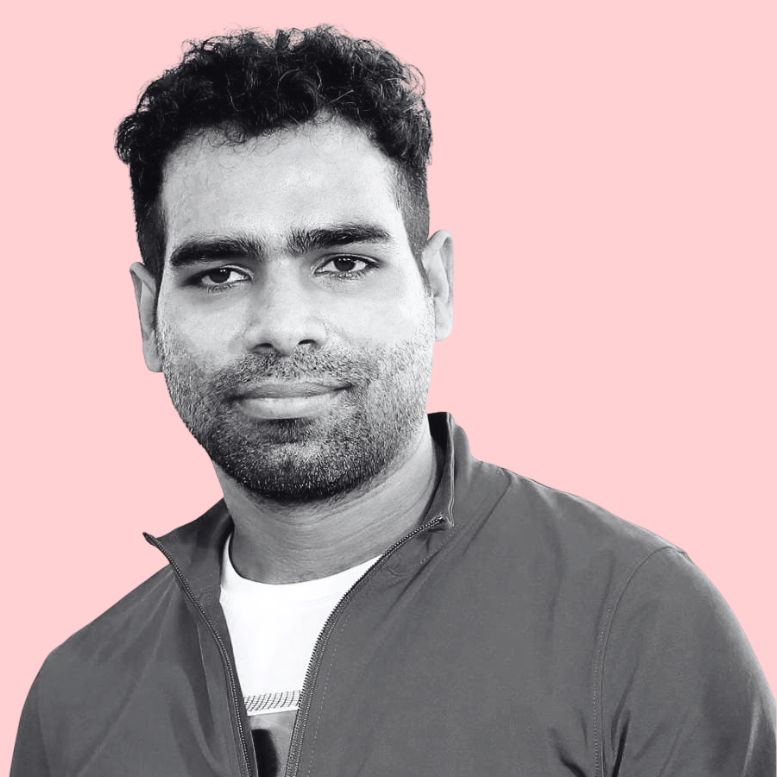
Irshad Md
5 years in practice
Online session: Video
Languages: English, Hindi, Telugu, Urdu
Fee: ₹2000 per session

Dr Rainy Bhuyan
12 years in practice
MPT Neurosciences and Psychosomatic Disorders, Internationally Certified Aura Reader
Online session: Video
Languages: English, Hindi, Gujarati
Fee: ₹1000 per session
Fees and availability shown come from each practitioner’s own current settings. Read more about Adult Counselling.
What to Consider When Choosing a Practitioner
Professional role and scope
What a practitioner is qualified to do differs. If assessment for something like anxiety or depression may be relevant, that shapes who is appropriate.
Qualifications
The degree or training they hold and the institution that issued it, as they have provided it.
Services offered
What you can actually book with them, and the current fee for each.
Years in practice
Calculated from the year they started. Longer is not the same as better suited to you.
How they describe their work
Each profile carries the practitioner’s own account of how they practise, including their approach where they have listed one.
Languages and availability
The languages they offer sessions in, and when they have time open.
Not every practitioner offering Adult Counselling works in the same way or with the same concerns, and none of them has been assessed by LifeHetu for work stress in particular. Reading the full profile is the only reliable way to tell what someone offers. This listing is not ranked or scored.
Explore Professional Support Options
Review practitioners offering Adult Counselling through LifeHetu, their professional backgrounds and current online booking options.