Depression: Symptoms, Support and Treatment Options
Depression is more than a temporary period of sadness or low mood. It can affect emotions, thinking, motivation, sleep, energy and everyday functioning — and effective treatments for it exist.
This page explains what depression is, how it differs from ordinary sadness, how it can present, what can contribute to it, how it is professionally assessed, what treatment and support can involve, and when a situation needs urgent help rather than a scheduled appointment. It is general information, not an assessment of you.

What Is Depression?
Depressive disorder — usually just called depression — is a recognised mental health condition. The World Health Organization describes it as involving a depressed mood, or a loss of pleasure or interest in activities, for long periods of time, and states plainly that it is different from the regular mood changes and feelings of everyday life.
It is not confined to mood. Depression can affect how a person thinks, how they sleep, what they eat, how much energy they have, how well they concentrate, how they feel about themselves, and how they manage at home, at work, at school and with the people around them. Two people with the same diagnosis can look quite different from each other, and one person can look different from one week to the next.
Depression can happen to anyone. It is common: the WHO estimates that around 5.7% of adults live with depression worldwide — approximately 332 million people — drawing on modelled 2021 Global Burden of Disease figures rather than a direct count, and reporting it as roughly 1.5 times more common among women than among men. That is context, not a diagnosis, and it says nothing about any individual reader.
Nothing on this page can establish whether someone has depression. That is a clinical judgement, made by an appropriately qualified professional who can ask questions a web page cannot.
How Is Depression Different From Sadness or Low Mood?
This is the question people most often arrive with, and the honest answer is more involved than a number of weeks.
Sadness is a normal human emotion, and low mood is a normal response to difficulty. Losing something that mattered, a relationship ending, a job going, an exam result, a move away from people you rely on — feeling low afterwards is not a malfunction. Most low mood lifts as circumstances change or as a person adjusts, and the NHS notes that a low mood may improve after a short period rather than being a sign of depression.
A depressive disorder is a clinically significant pattern rather than a single feeling. What distinguishes it is not one factor but several together: the nature of the symptoms and how many are present, how severe they are, how much distress they cause, how far they interfere with everyday functioning, how long they have continued, and the context they are occurring in.
Duration is part of that picture. The WHO describes a depressive episode as differing from ordinary mood fluctuation in that the symptoms are present most of the day, nearly every day, for at least two weeks, with other symptoms alongside the change in mood. That criterion belongs to professional assessment, not to self-assessment.
Two weeks is a clinical criterion, not a waiting period
The previous version of this page advised readers to seek support if symptoms persisted "for more than two weeks". That inverted the criterion into a delay. Nobody needs to endure an arbitrary interval before asking for professional support, and a person having thoughts of self-harm or suicide should not wait at all. Equally, feeling low for a fortnight does not by itself mean a person has depression — several other things have to be true, and only an assessment can establish them.
Grief and depression are not the same thing
Someone who is grieving can experience sadness, disturbed sleep, changes in appetite, difficulty concentrating and reduced interest in things they used to care about. Those experiences overlap with depression, and bereavement is one of the adverse life events the WHO identifies as making depression more likely.
Overlap is not identity. Grief is a response to loss and follows its own course; a depressive disorder is a clinical condition. They can occur together, and telling them apart in a particular person is exactly the kind of judgement that needs a professional rather than a page. Nothing here is intended to tell a bereaved reader what they are experiencing.
How Can Depression Show Up?
Depression does not look the same in everyone, and it does not always look like sadness. Some people describe emptiness or numbness rather than unhappiness; some are mainly irritable; some notice the physical changes first. No one has all of the following, and having some of them does not establish a diagnosis.
Mood and emotion
A depressed mood — feeling sad, low, empty or irritable
Loss of interest or pleasure in activities that used to matter
Hopelessness about the future
Feeling emotionally flat or numb rather than actively unhappy
Tearfulness, in some people
Thinking
Poor concentration, or difficulty holding attention
Difficulty making decisions
Persistent negative or self-critical thoughts
Feelings of excessive guilt or low self-worth
Thoughts about dying or suicide
Body and behaviour
Disrupted sleep — sleeping much less, or much more
Changes in appetite or weight
Feeling very tired, or low in energy
Moving or speaking more slowly than usual, or feeling restless and agitated
Withdrawing from people and stepping back from activities
Finding usual responsibilities at home, work or study harder to manage
Every one of these can have causes other than depression, including physical health conditions, the effects of medication, sleep problems, substance use, and simply being under sustained strain. This is a description of how depression can present, not a checklist to score — there is no number of items that means anything on its own, and severity depends on the whole picture rather than a count.
Thoughts about death and suicide
Thoughts about dying or about suicide are among the symptoms the World Health Organization lists for a depressive episode, and they deserve to be named rather than skirted around. They do not occur for everyone who is depressed, and having them does not mean a person will act on them. They do mean the situation warrants professional attention rather than waiting to see. If this is where you are right now, the guidance in the next section applies before anything else on this page.
If You Are Having Thoughts of Suicide or Self-Harm
Most people who read a page about depression are not in immediate danger, and this section is not addressed to everyone. It is here, and it is here early, because when it does apply nothing else on the page matters more.
If you are having thoughts of self-harm or suicide, or someone is in immediate danger, go to the nearest hospital or emergency room, where you can see a psychiatrist, counsellor or therapist in person. Do not wait for a scheduled session. Involving a family member or friend who can be with you helps.
Booking a session through LifeHetu is a scheduled conversation with a practitioner at a future time. It is not an emergency service. Booking, sending an enquiry or messaging will not reach anyone immediately, and it is not the route for a situation that needs help now — whether that is thoughts of suicide, having harmed yourself, being unable to stay safe, or acute symptoms needing urgent medical attention.
The World Health Organization’s guidance for anyone having thoughts of suicide is that you are not alone, that talking to someone you trust and to a health worker such as a doctor or counsellor helps, and that if you think you are in immediate danger of harming yourself you should contact any available emergency service or crisis line.
This is about urgency rather than about online support being inadequate. Ongoing depression is treated online as well as in person. What a scheduled appointment cannot do — in either format — is respond to something happening right now.
Different Forms Depression Can Take
Depression is not a single uniform condition, and the pattern matters to how it is assessed and treated. What follows is a short orientation, not diagnostic criteria and not a complete classification.
A single depressive episode
The WHO describes single episode depressive disorder as a person’s first and only episode. Severity is categorised as mild, moderate or severe depending on the number and severity of symptoms and the effect on the person’s functioning.
Recurrent depression
Recurrent depressive disorder means a history of at least two depressive episodes. A recurring pattern can change what is considered appropriate, which is one reason assessment asks about the past and not only the present.
Longer-lasting, lower-grade depression
Some depressive conditions are less intense but far more persistent, continuing for years rather than weeks. ICD-11 classifies this as dysthymic disorder. Because it can feel like a personality trait rather than an illness, it often goes unrecognised for a long time.
Depression with anxiety
Depression and anxiety frequently occur together, and ICD-11 includes a mixed depressive and anxiety disorder category for presentations where neither predominates. Having both is common rather than unusual.
During pregnancy and after birth
The WHO reports that more than 10% of pregnant women and women who have just given birth experience depression. Perinatal depression needs care from professionals with relevant expertise, and this page deliberately does not offer pregnancy-related or postnatal treatment guidance.
Seasonal and other patterns
Some people experience depressive episodes in a seasonal pattern. Depressive symptoms can also arise in the context of physical illness, or alongside the use of certain medications or substances. Establishing which pattern applies is part of professional assessment.
Depression within bipolar disorder is not the same condition
The WHO lists bipolar disorder among the patterns in which depressive episodes occur: depressive episodes alternating with periods of manic symptoms, which can include euphoria or irritability, increased activity or energy, talking rapidly, racing thoughts, an inflated sense of self-esteem, a decreased need for sleep, distractibility and reckless or impulsive behaviour. A depressive episode within bipolar disorder can look identical to one that is not.
The distinction matters because the WHO states that different medications and treatments are used for bipolar disorder. A past period of unusually elevated or irritable mood with increased activity is therefore something an assessing professional needs to know about. This page does not offer a bipolar self-screen, and no one should attempt to work this out from a description.
What Can Contribute to Depression?
The WHO describes depression as resulting from a complex interaction of social, psychological and biological factors. There is rarely a single cause, and the factors below raise likelihood — none of them makes depression inevitable, and their absence does not rule it out.
Adverse and stressful life events
The WHO identifies unemployment, bereavement and traumatic events among the experiences that make depression more likely. The NHS adds relationship breakdown, illness, and money or job worries; often several combine rather than one acting alone.
Family history and biology
Depression is more likely in people with a family history of it, and NIMH describes genetic and biological factors as playing a role alongside environmental and psychological ones. A family history is not a forecast.
Physical health
The WHO states that depression is closely related to and affected by physical health. The NHS notes higher risk with longstanding or life-threatening illness, conditions causing long-term pain, head injuries, and an underactive thyroid.
Alcohol, drugs and some medications
Alcohol and drug use can interact with depression in both directions — the WHO names harmful alcohol use among the factors involved, and the NHS notes that some people drink or use drugs in response to low mood, which can deepen it. Some prescribed medicines can also affect mood.
Isolation and circumstances
Loneliness and becoming cut off from family and friends increase risk, and depression is more common among people living in difficult social and economic circumstances. Depression can in turn worsen the situation that contributed to it.
Psychological factors
The NHS notes that traits such as low self-esteem or being strongly self-critical can increase vulnerability, arising from inherited factors, early life experience, or both.
Depression is often explained as being "caused by a chemical imbalance" or "low serotonin". That shorthand is not how the authoritative sources describe it — the WHO frames depression as arising from an interaction of social, psychological and biological factors, and no single-substance explanation accounts for it. It also does something unhelpful, by suggesting there is one thing wrong and one thing to fix. Nothing on this page can tell any individual what contributed to their own depression; that is part of what assessment is for.
Depression-Like Symptoms Can Have Physical Causes
Fatigue, disturbed sleep, appetite change, low energy and difficulty concentrating are all listed among the symptoms of depression — and all of them occur in physical health conditions too, in medication side effects, and in ordinary sleep deprivation. Assuming the explanation before it has been established is a mistake in either direction.
This is one reason assessment may consider physical health, current medication and substance use alongside mental health, and why a doctor may be involved as well as a mental health professional. New, unexplained or worsening physical symptoms deserve medical assessment rather than being attributed to mood.
When Might It Help to Speak With a Professional?
There is no threshold you have to cross first, and no minimum period you are expected to have endured. People often find it useful in situations like these.
Low mood, or a loss of interest in things that used to matter, has persisted
What you are experiencing is causing you significant distress
Work, study or looking after yourself is becoming harder to manage
Relationships or responsibilities are being affected
Sleep, appetite or energy have changed noticeably
You feel unable to cope, or unlike yourself, and cannot see why
You are having thoughts of self-harm, suicide or death
You simply want help understanding what is going on
The WHO’s advice is direct: seek care if you have symptoms of depression. You do not need to be certain that what you are experiencing is depression before speaking to someone — working that out is the professional’s job, not a prerequisite. And where there are thoughts of self-harm or suicide, the urgent guidance above applies rather than a scheduled appointment.
How Is Depression Professionally Assessed?
Assessment is a conversation, not a test. An appropriately qualified professional will usually explore what a person is currently experiencing, how long it has been going on, how severe it is, how much it is affecting day-to-day functioning, what else has been happening in their life, their medical history and any medication or substances involved, any previous mental health difficulties or episodes, other mental health symptoms that may be present, and safety.
Standardised questionnaires are used in some settings as one input among several. A questionnaire score is not a diagnosis on its own, and no online quiz — including any that describes itself as a depression test — can produce one.
Assessment also considers what else could account for the picture: a physical health condition, the effects of a medication, substance use, or a different mental health condition. The presence or absence of past manic or hypomanic episodes is part of that, since it changes what is appropriate.
Counsellors and psychotherapists
Provide counselling or psychotherapy within the scope their qualifications and professional background allow. Not every practitioner assesses or diagnoses — what someone is qualified to do varies, and it is worth checking rather than assuming.
Psychologists
Work with psychological assessment and psychological treatment. What an individual psychologist is qualified and registered to do differs by training and jurisdiction, and psychologists do not prescribe medication.
Psychiatrists
Medical doctors specialising in mental health. They can carry out medical assessment, consider physical contributors and prescribe medication where appropriate — and their work is not limited to prescribing; many also provide or oversee psychological treatment.
Doctors and other medical professionals
Often the first point of contact, and relevant where physical health, medication effects or investigations need to be considered as part of the picture.
LifeHetu does not assess, diagnose or treat anyone. It lists independent practitioners, shows what each one offers, and lets you book an online session with them. What happens in that session is between you and the practitioner, and the professional scope belongs to them.
What Can Treatment and Support for Depression Involve?
The World Health Organization states that there are effective treatments for depression, and that these include psychological treatment and medications. What is appropriate for a particular person depends on the type and severity of the depression, their circumstances, other conditions, their own preferences and professional assessment — so there is no single combination that is right for everyone.
Psychological therapies
The WHO describes psychological treatments as the first treatments for depression, and lists behavioural activation, cognitive behavioural therapy, interpersonal psychotherapy and problem-solving therapy among the effective ones. These approaches work in different ways — some focus on thoughts and behaviour, some on relationships, some on re-engaging with activity — and the WHO notes that talk therapy can happen in person or online.
Cognitive behavioural therapy is among the most extensively studied, but it is not the only effective approach and it is not universally the right one. No approach cures depression on demand, and which one suits a particular person is a matter for discussion with the professional they are working with. Individual practitioner profiles on LifeHetu describe how each practitioner works, where they have provided that; LifeHetu does not deliver any therapy itself and does not decide which approach anyone should have.
Medication and medical care
Antidepressant medication may be considered in some circumstances, following appropriate medical assessment. The WHO’s position is specific: psychological treatments come first, antidepressant medications are not needed for mild depression, and they may be combined with psychological treatment in moderate and severe depression. It notes that antidepressants include selective serotonin reuptake inhibitors, and that prescribers weigh possible adverse effects, what treatment can actually be delivered, and individual preference.
This page gives no drug recommendations, no doses and no instructions to start, stop or change anything. Those decisions belong to an appropriately qualified prescribing professional who has assessed the individual. LifeHetu does not prescribe medication, and if you are already taking something, do not change it on the basis of a web page.
Medication for children and adolescents is treated differently again: the WHO states that antidepressants should not be used to treat depression in children, and are not the first line of treatment in adolescents, among whom they should be used with extra caution.
Social and practical support
Depression rarely sits apart from a person’s circumstances. Support that addresses what is actually happening — isolation, work or study pressure, money or housing difficulty, caring responsibilities, or a physical health condition that is contributing — can be part of what helps, alongside psychological treatment rather than instead of it.
When more than counselling may be needed
Routine counselling is not the appropriate response to every depressive presentation. Severe depression, depression that has not improved with treatment already tried, depression occurring within bipolar disorder, or a situation involving significant risk may call for psychiatric assessment, medical assessment or more intensive mental health services. The NHS describes severe depression as warranting referral to a specialist mental health team.
This is not a reason to avoid speaking to someone. It is a reason to be open in an assessment about the full picture, so that the professional can say what is appropriate — including, where it is, that something other than what you booked is needed.
Individual outcomes and timelines vary, and no one can promise a particular result in advance. There is no fixed number of sessions and no standard length of treatment; anyone who quotes you one before meeting you is guessing.
Everyday Measures That May Support Wellbeing
The World Health Organization publishes self-care suggestions for people managing symptoms of depression. These sit alongside professional treatment rather than replacing it, and the WHO’s own list ends with seeking help from a healthcare provider.
Keep some connection
Staying in contact with friends and family, and talking to someone you trust about how you feel.
Hold on to activities where you can
Trying to keep doing things you used to enjoy, even when the enjoyment is not there yet.
Some movement
Exercising regularly, the WHO suggests, even if it is just a short walk.
Regular eating and sleeping
Sticking to regular eating and sleeping habits as much as possible.
Care with alcohol and drugs
Avoiding or cutting down on alcohol, and not using illicit drugs, which the WHO notes can make depression worse.
Ask for help
Seeking help from a healthcare provider — the WHO lists this as part of self-care, not as an alternative to it.
Two things this list is not. It is not a treatment for depression, and none of it is a substitute for professional care where that is needed. And it is not a standard to be judged against: difficulty with sleep, appetite, activity and motivation is part of what depression does, so being unable to keep these up is a symptom rather than a failure of effort. "Exercise releases endorphins" and similar claims oversimplify a genuinely complicated evidence picture. Anyone with a physical health condition should check with a doctor before changing their activity.
What LifeHetu Does, and What It Does Not
LifeHetu is a technology platform. It lists independent practitioners, publishes their professional profiles, and enables online session booking and payment. The practitioners listed are not employed by LifeHetu, and the professional relationship in a session is between you and the practitioner.
LifeHetu does not diagnose depression, treat it, provide therapy, prescribe medication, design treatment plans, clinically match anyone to a practitioner or monitor anyone’s progress. It does not certify anyone as a depression specialist. Where this page describes what treatment can involve, it is describing what professionals do — not what LifeHetu does.
What is discussed with a practitioner is handled under that practitioner’s own professional and ethical obligations, which include recognised limits — situations involving risk of serious harm being the usual example. Any handling of your information by LifeHetu itself is governed by its published privacy policy. This page makes no absolute confidentiality guarantee, because no honest one exists.
Where to Find Professional Support
LifeHetu lists independent practitioners and lets you book an online session with one of them. It does not maintain a list of depression specialists — practitioner records carry the services someone offers, not verified condition specialisms, so any such list would be guesswork. What you can do is read profiles and judge for yourself.
How Online Booking Through LifeHetu Works
Explore practitioners
Browse who is listed, with search and filters. Nothing is behind a sign-up.
Read the profile
Qualifications, years in practice, languages, the services they offer and how they describe their own work are on each profile.
Choose the service
Pick the service you want from the ones that practitioner offers. The current fee is shown for it.
Pick a time
Availability comes live from the practitioner’s own calendar at the moment you book, so the times shown are the ones actually open.
Confirm and pay
Complete the booking, and you receive the details for your session.
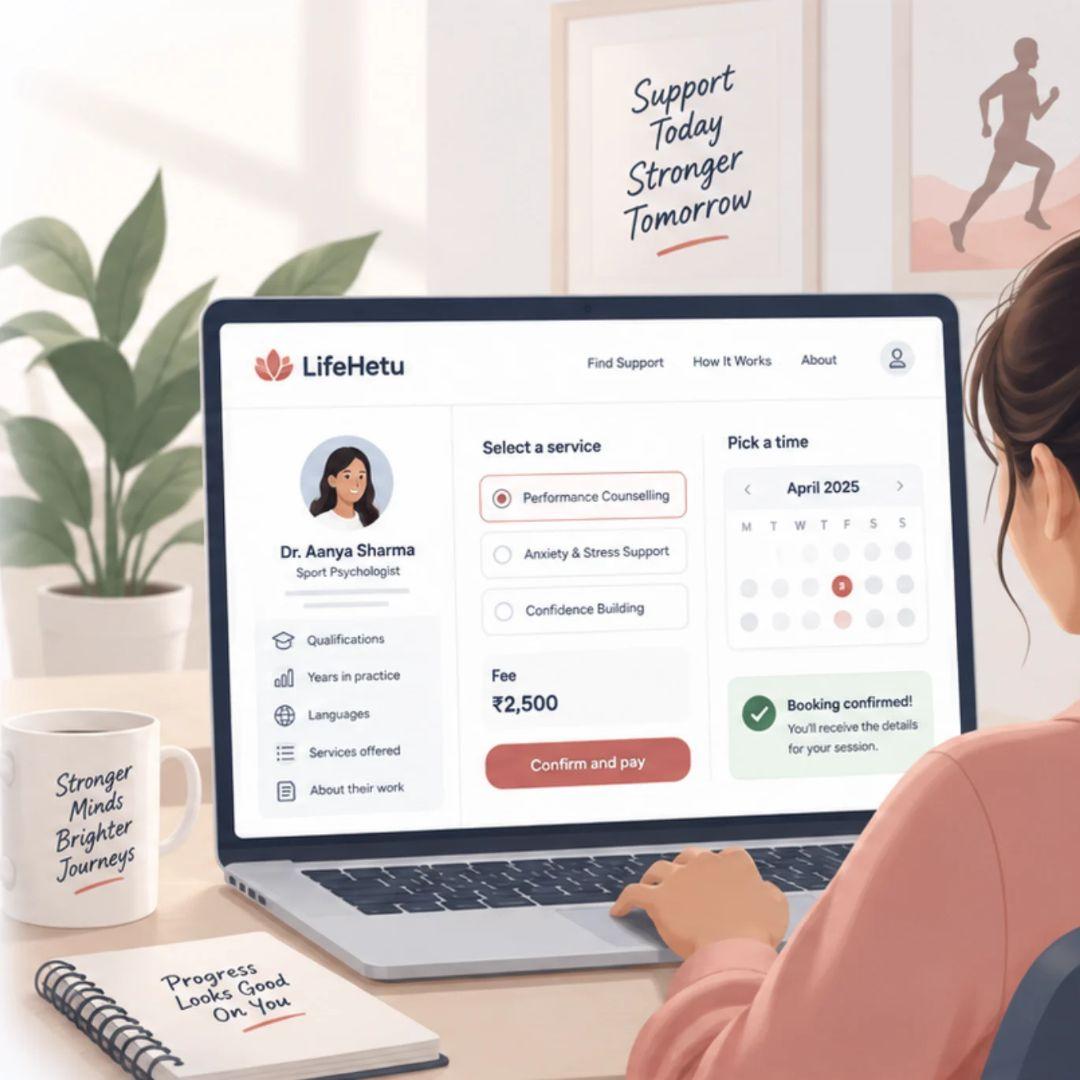
Sessions Are Booked Online
Sessions booked through LifeHetu are online. After connecting with a practitioner, you may discuss directly whether an in-person session could be an option in the future. Any such arrangement depends on the practitioner and is not managed by LifeHetu.
Related Pages
Questions About Depression
Depression, or depressive disorder, is a recognised mental health condition. The World Health Organization describes it as involving a depressed mood, or a loss of pleasure or interest in activities, for long periods of time, and states that it is different from the regular mood changes of everyday life. It can affect mood, thinking, sleep, appetite, energy, concentration, how a person feels about themselves and how they function day to day.
Sadness is a normal emotion and low mood is a normal response to difficulty; both usually shift as circumstances change. A depressive disorder is a clinically significant pattern, distinguished not by one factor but by several together — the nature and number of symptoms, their severity, the distress they cause, how much they interfere with everyday functioning, how long they have continued, and the context. The WHO describes a depressive episode as involving symptoms present most of the day, nearly every day, for at least two weeks. That is a criterion used in professional assessment, not a rule you can apply to yourself.
No. The two-week duration is one element of how a clinician recognises a depressive episode, alongside a change in mood or loss of interest, other symptoms being present, and an effect on functioning — and the assessment considers severity, distress and context as well. Feeling low for a fortnight does not by itself establish a diagnosis, and equally you do not have to wait two weeks before asking for support. If you are having thoughts of self-harm or suicide, do not wait at all.
The WHO lists a depressed mood and loss of pleasure or interest in activities, along with poor concentration, feelings of excessive guilt or low self-worth, hopelessness about the future, thoughts about dying or suicide, disrupted sleep, changes in appetite or weight, and feeling very tired or low in energy. Nobody experiences all of them, all of these can have causes other than depression, and there is no number of them that means anything on its own.
No. Some people describe emptiness or numbness rather than unhappiness, and irritability is part of how the WHO describes a depressed mood. For some people the physical changes — sleep, appetite, energy — are what they notice first, and loss of interest or pleasure can be more prominent than low mood. Depression that does not look like sadness is still depression.
No, although they overlap. Grief can involve sadness, disturbed sleep, appetite changes, poor concentration and reduced interest, and bereavement is among the adverse life events that make depression more likely. But grief is a response to loss that follows its own course, and a depressive disorder is a clinical condition. They can occur together, and telling them apart in an individual is a judgement for a professional rather than a web page.
Yes. Fatigue, disturbed sleep, appetite change, low energy and difficulty concentrating occur in physical health conditions, as side effects of some medications, and in ordinary sleep deprivation. The NHS notes that an underactive thyroid can cause depression, and that longstanding illness, long-term pain and head injuries all raise risk. This is why assessment may consider physical health and current medication, and why new, unexplained or worsening physical symptoms deserve medical assessment rather than being attributed to mood.
Through assessment by an appropriately qualified professional — usually a conversation covering current symptoms, how long they have continued, severity, effect on daily functioning, medical history, medication and substance use, previous mental health history, other mental health symptoms and safety. Standardised questionnaires are used in some settings as one input, but a questionnaire score is not a diagnosis and no online test can produce one. Not every practitioner assesses or diagnoses — it depends on their profession and scope — and LifeHetu itself does not diagnose anyone.
The World Health Organization states that there are effective treatments for depression, including psychological treatment and medications, and that treatment exists for mild, moderate and severe depression. The most appropriate approach depends on the person, the symptoms, the clinical context and professional assessment. Individual outcomes and timelines vary, and nobody can promise a particular result in advance.
No. The WHO describes psychological treatments as the first treatments for depression and states that antidepressant medications are not needed for mild depression, though they may be combined with psychological treatment in moderate and severe depression. Whether medication is appropriate is a decision for an appropriately qualified prescribing professional after individual assessment — not something to conclude from a web page in either direction. LifeHetu does not prescribe, and if you already take something, do not change it without speaking to whoever prescribed it.
A psychiatrist is a medical doctor specialising in mental health, able to carry out medical assessment, consider physical contributors and prescribe medication where appropriate; many also provide or oversee psychological treatment. A psychologist works with psychological assessment and psychological treatment and does not prescribe medication. Counsellors and psychotherapists provide counselling or psychotherapy within the scope their qualifications allow. What any individual is qualified and registered to do varies, so it is worth checking rather than assuming.
Yes, and it commonly does. The NHS notes that many people with depression also have symptoms of anxiety, and ICD-11 includes a mixed depressive and anxiety disorder category for presentations where neither clearly predominates. Having both is usual rather than unusual, and it is something to mention in an assessment.
There is no universal number. It depends on what you are dealing with, how long it has been going on, what else is happening in your life, the approach used, and your own circumstances. Anyone who gives you a figure before meeting you is guessing.
Do not wait for a scheduled appointment. Booking a session through LifeHetu is a conversation at a future time and is not an emergency service. If you are having thoughts of self-harm or suicide, or someone is in immediate danger, go to the nearest hospital or emergency room, where you can see a psychiatrist, counsellor or therapist in person, and involve a family member or friend who can be with you. The WHO’s guidance is that you are not alone, that talking to someone you trust and to a health worker such as a doctor or counsellor helps, and that if you think you are in immediate danger of harming yourself you should contact any available emergency service or crisis line.
Yes. LifeHetu lists independent practitioners and enables online session booking; practitioners offering Adult Counselling are listed on this page with their current fees. Whether online support is appropriate depends on the individual, the concern and the practitioner. After connecting with a practitioner you may discuss with them whether meeting in person could be an option in future; any such arrangement is between you and them and is not managed by LifeHetu.
Sources & References
- World Health Organization — Depressive disorder (depression)The definition of depression and its distinction from regular mood changes; the symptom list; the two-week episode criterion; mild, moderate and severe categorisation; single episode, recurrent and bipolar patterns; the prevalence estimate; contributing factors and the relationship with physical health; that psychological treatments are the first treatments and antidepressants are not needed for mild depression; the effective psychological treatments named; guidance on antidepressants in children and adolescents; the self-care suggestions; and the guidance for anyone having thoughts of suicide.
- World Health Organization — Bipolar disorderThe description of manic and hypomanic symptoms, and that different medications and treatments are used for bipolar disorder.
- World Health Organization — ICD-11 classificationThe classification of dysthymic disorder and of mixed depressive and anxiety disorder.
- National Institute of Mental Health — DepressionThat low feelings usually pass with time while depression is different; that genetic, biological, environmental and psychological factors play a role; and that depression is a risk factor for suicidal thoughts and behaviours.
- NHS — Depression in adultsThat a low mood may improve after a short period rather than being a sign of depression; the physical symptoms described; that many people with depression also have symptoms of anxiety; and that severe depression may warrant referral to a specialist mental health team.
- NHS — Causes of depression in adultsThat there is no single cause; the life events, family history, personality, loneliness, alcohol and drug factors described; and that longstanding or life-threatening illness, long-term pain, head injuries and an underactive thyroid can be involved.
- American Psychological Association — DepressionThe distinction between ordinary low mood and a depressive disorder, and the role of psychological treatment.
- NIMHANS — National Institute of Mental Health and NeurosciencesIndian context for mental health services and where in-person clinical care is accessed.
Explore Practitioners Offering Adult Counselling
Depression is one of many concerns people may choose to discuss in counselling. The practitioners below currently offer Adult Counselling through LifeHetu. Review each practitioner’s professional background, qualifications and listed services before deciding who you would like to speak with.
This list is based on who currently offers Adult Counselling, not on any assessment of expertise in depression. LifeHetu does not certify anyone as a depression specialist, does not rank practitioners and does not match you to one. Professional scope differs between them, so read the full profile. If assessment, medication or more intensive care may be relevant, that is worth raising early.
9 practitioners offering Adult Counselling

Mr Abhishek Faria
6 years in practice
Doctoral Candidate at California Southern University
Online session: Video · Phone Call · Chat
Languages: English, Hindi, Marathi, Gujarati
Fee: ₹1800 per session

Ms Priya Parwani
6 years in practice
Bachelor's in Psychology Master's in Psychology PG Diploma in Counselling Psychology
Online session: Video
Languages: English, Hindi
Fee: ₹1000 per session

Mrs Mahalakshmi Rajagopal
28 years in practice
MSW, MSc
Online session: Video
Languages: English, Hindi, Tamil, Kannada, Telugu, Malayalam
Fee: ₹1800 per session

Ms Sonali Sikdar
16 years in practice
Online session: Video
Languages: English, Hindi, Marathi
Fee: ₹1500 per session

Dr. S.S. Saini
10 years in practice
M.Phil (Clinical Psychology), Ph.D (Clinical Psychology),PGDCBM with 10 years experience
Online session: Video · Phone Call
Languages: English, Hindi, Punjabi
Fee: ₹1500 per session

Dr Jignesh Ahir
11 years in practice
Masters in Applied Psychology, M.Phil. Ph.D in Psychology Research Gold Medalist
Online session: Video · Call · Chat
Languages: English, Hindi, Gujrati
Fee: ₹2000 per session

Ms Parinaaz Irani
8 years in practice
Online session: Video
Languages: English, Hindi, Marathi, Gujarati
Fee: ₹1500 per session

Irshad Md
5 years in practice
Online session: Video
Languages: English, Hindi, Telugu, Urdu
Fee: ₹2000 per session

Dr Rainy Bhuyan
12 years in practice
MPT Neurosciences and Psychosomatic Disorders, Internationally Certified Aura Reader
Online session: Video
Languages: English, Hindi, Gujarati
Fee: ₹1000 per session
Fees and availability shown come from each practitioner’s own current settings. Read more about Adult Counselling.
What to Consider When Choosing a Practitioner
Professional role and scope
What a practitioner is qualified to do differs. If assessment, diagnosis or medication may be relevant to your situation, that shapes who is appropriate.
Qualifications
The degree or training they hold and the institution that issued it, as they have provided it.
Services offered
What you can actually book with them, and the current fee for each.
Years in practice
Calculated from the year they started. Longer is not the same as better suited to you.
How they describe their work
Each profile carries the practitioner’s own account of how they practise, including their approach where they have listed one.
Languages and availability
The languages they offer sessions in, and when they have time open.
Not every practitioner offering Adult Counselling works in the same way or with the same concerns, and none of them has been assessed by LifeHetu for depression in particular. Reading the full profile is the only reliable way to tell what someone offers. This listing is not ranked or scored.
Explore Professional Support Options
Review practitioners offering Adult Counselling through LifeHetu, their professional backgrounds and current online booking options.