Anxiety: Understanding Symptoms and Support Options
Anxiety can be an ordinary response to stress, uncertainty or pressure. For some people it becomes persistent or intense enough to interfere with everyday life, and that is worth taking seriously.
This page explains how anxiety can present, how anxiety differs from an anxiety disorder, what professional assessment and support can involve, and how to explore practitioners and book an available online session through LifeHetu. It is general information, not an assessment of you.

Anxiety Is Not Always an Anxiety Disorder
Anxiety is a normal human response. Feeling anxious before an exam, a medical result, a difficult conversation or a change you did not choose is what the response is for — it raises alertness when something matters. Experiencing anxiety does not by itself mean a person has a mental health condition.
Anxiety disorders are something more specific: recognised conditions defined by particular patterns of fear or anxiety, along with related symptoms and behaviour such as avoidance. Whether someone meets the criteria for one depends on the nature of the symptoms, how intense they are, how long they have continued, the situations that trigger them, how much distress they cause and how much they interfere with daily life. The World Health Organization describes people with anxiety disorders as typically experiencing these symptoms over an extended period — at least several months — though duration alone is not what defines a disorder.
The criteria differ between individual disorders, and applying them is a clinical judgement made by an appropriately qualified professional who can ask questions this page cannot. Nothing here can tell you whether you have an anxiety disorder, and nothing here is intended to.
How Can Anxiety Show Up?
Anxiety is not only a feeling — it involves the body and behaviour too. People describe it differently, and no one has all of these. What follows is a description of how anxiety can present, not a list to count.
Thoughts and emotions
Worry that is excessive, or hard to control once it starts
Fear, or a sense of dread that is difficult to place
Feeling tense, restless or on edge
Difficulty concentrating, or losing your thread
Irritability
Physical experiences
A faster or pounding heartbeat
Sweating, or trembling
Muscle tension
Stomach discomfort or nausea
Dizziness or light-headedness
Changes in breathing
Difficulty falling or staying asleep
Behaviour
Avoiding situations, places or conversations
Seeking reassurance repeatedly
Finding it hard to do things because of worry or fear
Preparing or checking far more than a situation calls for
Many of these experiences can occur for reasons other than an anxiety disorder — including physical health conditions, medication, substances, sleep loss and ordinary stress. A qualified professional can help work out what may be contributing to them. Counting how many apply to you will not answer that question.
When Physical Symptoms Need Medical Attention
Several experiences associated with anxiety overlap with symptoms of physical illness — chest discomfort, a racing heart, breathlessness, dizziness and stomach symptoms among them. Anxiety is not the only explanation for any of them, and assuming it is can delay care that someone needs.
New, severe, unexplained or worsening physical symptoms deserve medical assessment rather than being attributed to anxiety. This is particularly true of chest pain, severe breathlessness, fainting or sudden neurological symptoms, which need urgent medical attention. A doctor can assess what is happening; this page cannot, and neither can a counselling session.
What Are Some Types of Anxiety Disorders?
Anxiety disorders are a group of related conditions rather than one thing. The World Health Organization describes several, including:
Generalised anxiety disorder
Persistent and excessive worry about everyday activities or events, across a broad range of situations.
Panic disorder
Panic attacks, together with fear of further panic attacks.
Social anxiety disorder
Marked fear and worry about social situations that might lead to feeling humiliated, embarrassed or rejected.
Agoraphobia
Fear, worry and avoidance of situations that might cause panic, or in which a person might feel trapped or helpless.
Separation anxiety disorder
Excessive fear or worry about separation from people with whom a person has a deep emotional bond.
Specific phobias
Intense fears of particular objects or situations, leading to avoidance and significant distress.
Selective mutism
A consistent inability to speak in certain social situations, despite being able to speak in others.
These descriptions are summaries, not diagnostic criteria. Recognising something in one of them does not establish that you have that condition, and several of these conditions share features with each other and with other diagnoses.
What is not classified as an anxiety disorder
Obsessive-compulsive disorder (OCD) and post-traumatic stress disorder (PTSD) are frequently described as anxiety disorders — including, until now, elsewhere on this site. They are not. In current classification systems, including ICD-11 and DSM-5, OCD sits within obsessive-compulsive and related disorders, and PTSD within disorders specifically associated with stress. Both can involve considerable anxiety, and the distinction matters because assessment and treatment differ.
What Can Contribute to Anxiety?
There is no single cause. Anxiety disorders are generally understood to develop from a combination of factors that differ between people, and which interact rather than acting alone. Those may include:
Family history and genetics
A degree of inherited vulnerability, which raises likelihood rather than determining it.
Temperament
Longstanding traits, such as a tendency towards caution or sensitivity to threat.
Life experiences
Including difficult, frightening or prolonged experiences, particularly earlier in life.
Sustained stress
Significant or ongoing pressure — work, money, caring responsibilities, insecurity, illness.
Physical health
Some health conditions are associated with anxiety symptoms, which is one reason medical assessment can matter.
Substances and medication
Some substances and medicines, and withdrawal from them, can produce or worsen anxiety symptoms.
You will not find out from this page which of these applies to you, and it is common for no single explanation to emerge. A widely repeated claim that anxiety is caused by a chemical imbalance such as low serotonin oversimplifies what is actually understood, and it is not the basis on which anxiety disorders are diagnosed or treated. If you take prescribed medication and wonder whether it is contributing, that is a question for the prescriber — not a reason to stop taking it.
When Might It Help to Speak With a Professional?
There is no threshold you have to cross first, and you do not need to be in crisis to be worth helping. People may find it useful to speak with a professional when:
Worry or fear is causing significant distress
Anxiety is getting in the way of work, study, relationships or daily activities
Avoidance is narrowing what you do, or where you go
Panic-like episodes keep happening
Sleep or concentration difficulties have persisted
Managing it is taking more effort than you can sustain
You simply want help understanding what you are experiencing
Wanting to understand something is reason enough. Equally, deciding not to seek support right now is a legitimate choice — this page is not telling anyone what they need.
How Is Anxiety Professionally Assessed?
Assessment is a conversation rather than a test. Depending on the professional and the setting, it may cover what you are experiencing now, how long it has been going on, the situations it arises in, how it affects your daily life, your medical history, any medication or substances that might be relevant, and whether anything else is going on alongside it. Some settings also use standardised questionnaires as one input among several.
Who can do what depends on their profession, training and scope of practice. Not every practitioner assesses or diagnoses, and a formal diagnosis is not always necessary for someone to be helped.
Psychologists and counselling professionals
May provide psychological assessment, counselling or psychotherapy, depending on their qualification and professional scope. What any individual offers is set out on their own profile.
Psychiatrists
Medical doctors specialising in mental health. They can carry out medical assessment and prescribe medication where appropriate. Not every psychiatrist offers psychotherapy.
Other doctors and healthcare professionals
Where physical symptoms or a possible medical contributor are involved, assessment by an appropriate physician may be needed alongside or before psychological support.
LifeHetu does not assess, diagnose or triage anyone. It lists independent practitioners and handles booking; what any of them is qualified to do is a matter for their own profile and their own professional body.
What Can Support for Anxiety Involve?
The World Health Organization states that there are highly effective treatments for anxiety disorders. What is appropriate for any individual depends on the specific disorder, its severity, what else is going on and what that person wants — so what follows describes the options that exist, not a plan for you.
Psychological therapies
Psychotherapy is an established treatment for anxiety disorders. Cognitive behavioural therapy (CBT) is one of the most extensively studied psychological treatments across several anxiety disorders, and it has good evidence behind it — but it is one well-supported option rather than the only legitimate one, and the specific approach that fits varies by disorder and by person.
For some anxiety disorders, approaches that involve gradually and deliberately approaching feared situations form part of treatment. That work is done with a trained professional who structures it. This page does not describe how to do it, and confronting feared situations on your own on the strength of a web page is not what those approaches are.
Medication
Medication is one treatment option for some anxiety disorders. The WHO notes that antidepressant medicines, such as SSRIs, can be useful in treating adults with anxiety disorders. Whether medication is appropriate, which one, and for how long are decisions for an appropriately qualified prescribing professional — usually a psychiatrist or a doctor — following individual assessment.
LifeHetu does not prescribe, recommend or supply medication, and this page deliberately does not name specific drugs or doses. If you are already taking something, do not change or stop it because of anything you read here; raise it with whoever prescribed it.
Everyday supportive strategies
The WHO notes that learning stress management skills, such as relaxation and mindfulness skills, can help reduce symptoms of anxiety disorders. A regular sleep routine, physical activity appropriate to your health, keeping some social contact, and reducing avoidable pressure where you can are all reasonable things to attend to.
These are supports, not substitutes. They do not replace assessment or treatment where those are needed, they do not work equally well for everyone, and describing them as a natural cure for anxiety would be both inaccurate and a good way to discourage someone from getting help they need.
Treatment helps many people, and outcomes and timelines vary between individuals. Anyone offering you a fixed number of sessions or a guaranteed result before meeting you is telling you something they cannot know.
Where to Find Professional Support
LifeHetu lists independent practitioners and lets you book an online session with one of them. It does not maintain a list of anxiety specialists — practitioner records do not carry verified condition specialisms, so any such list would be guesswork. What you can do is read profiles and see for yourself.
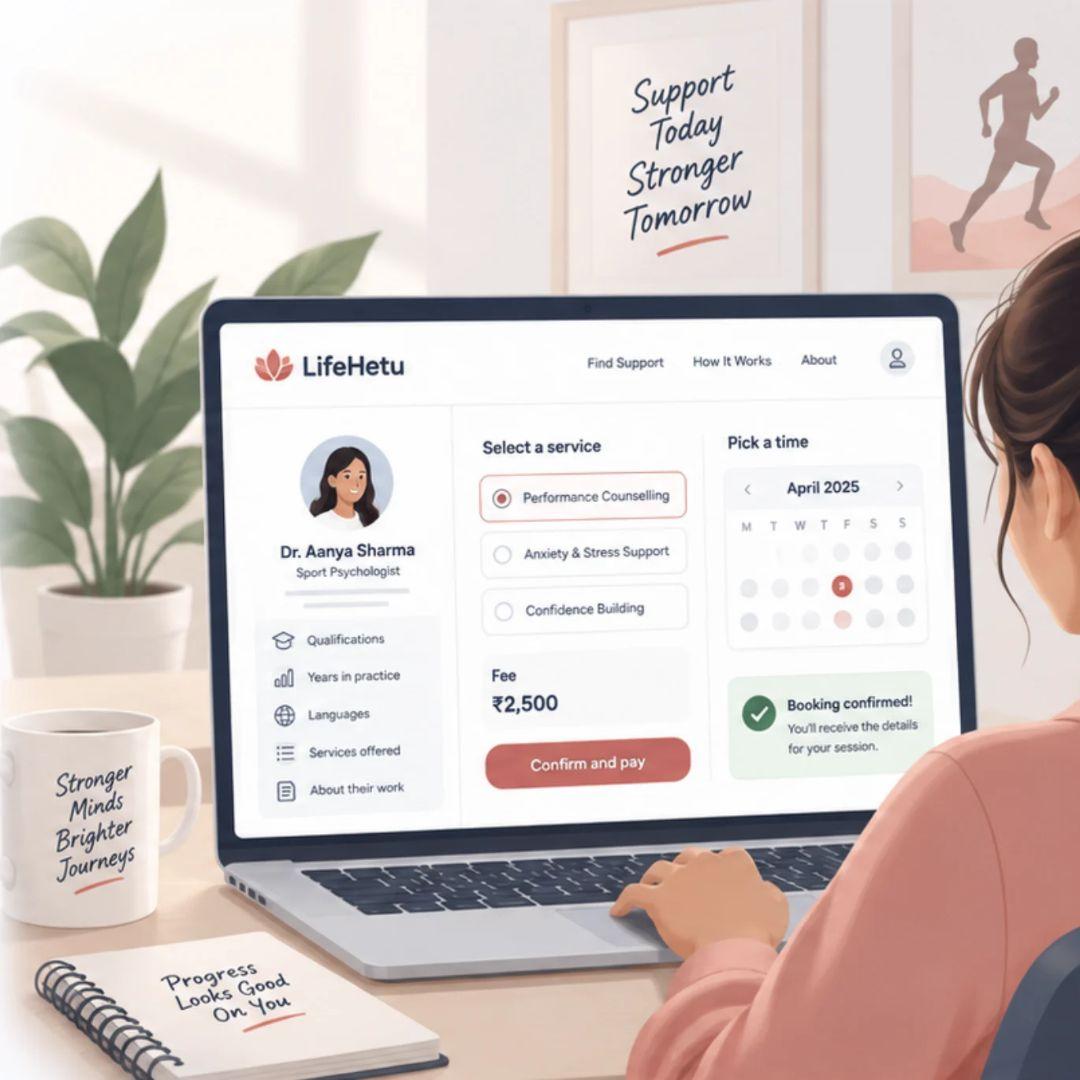
How Online Booking Through LifeHetu Works
Explore practitioners
Browse who is listed, with search and filters. Nothing is behind a sign-up.
Read the profile
Qualifications, years in practice, languages, the services they offer and how they describe their own work are on each profile.
Choose the service
Pick the service you want from the ones that practitioner offers. The fee is shown for it.
Pick a time
Availability comes live from the practitioner’s own calendar, so the times shown are the ones open.
Confirm and pay
Complete the booking, and you receive the details for your session.
Sessions Are Booked Online
Sessions booked through LifeHetu are online. After connecting with a practitioner, you may discuss directly whether meeting in person could be an option in the future. Any such arrangement depends on the practitioner and is not managed by LifeHetu.
If You Need Urgent Support
Booking a session through LifeHetu is a scheduled conversation with a practitioner. It is not an emergency service, and it is not the right route for a situation that needs help now.
If you are having thoughts of self-harm or suicide, or someone is in immediate danger, go to the nearest hospital or emergency room, where you can see a psychiatrist, counsellor or therapist in person. Do not wait for a scheduled session. Involving a family member or friend who can be with you helps.
For severe physical symptoms — chest pain, severe breathlessness, fainting or sudden neurological symptoms — urgent medical care is the right first step, whatever you think the cause may be.
Related Pages
Questions About Anxiety
Anxiety is a normal human response to threat, pressure or uncertainty — it raises alertness when something matters, and everyone experiences it. It involves thoughts and feelings, physical changes such as a faster heartbeat, and behaviour such as avoidance. Anxiety in itself is not a disorder.
Anxiety disorders are recognised conditions defined by particular patterns of fear or anxiety together with related symptoms and behaviour. Whether someone meets the criteria depends on the nature, intensity and duration of the symptoms, the situations that trigger them, the distress they cause and how much they interfere with daily life — assessed by a qualified professional. There is no simple rule such as "if it lasts a certain number of weeks it is a disorder", and this page cannot tell you which applies to you.
The World Health Organization describes several, including generalised anxiety disorder, panic disorder, social anxiety disorder, agoraphobia, separation anxiety disorder, specific phobias and selective mutism. These summaries are not diagnostic criteria, and several of these conditions share features with each other.
No, although they are often described that way. In current classification systems, including ICD-11 and DSM-5, obsessive-compulsive disorder sits within obsessive-compulsive and related disorders, and post-traumatic stress disorder within disorders specifically associated with stress. Both can involve considerable anxiety, but they are classified separately, and assessment and treatment differ.
Yes. A racing heart, chest discomfort, breathlessness, dizziness and stomach symptoms all have possible physical causes, and anxiety is only one explanation among several. New, severe, unexplained or worsening physical symptoms deserve medical assessment rather than being assumed to be anxiety. Chest pain, severe breathlessness, fainting or sudden neurological symptoms need urgent medical attention.
There is no threshold you have to cross first, and you do not need to be in crisis. People often find it useful when worry or fear is causing significant distress, when anxiety is interfering with work, study, relationships or daily activities, when avoidance is narrowing what they do, when panic-like episodes keep recurring, or simply when they want help understanding what they are experiencing.
Through assessment by an appropriately qualified professional. That usually means a conversation covering current experiences, how long they have continued, the situations involved, the effect on daily life, medical history, and any medication or substances that may be relevant; standardised questionnaires are used in some settings as one input. Not every practitioner assesses or diagnoses — it depends on their profession and scope — and LifeHetu itself does not diagnose anyone.
The World Health Organization states that there are highly effective treatments for anxiety disorders. Cognitive behavioural therapy is one of the most extensively studied psychological treatments across several anxiety disorders, and other approaches are used too — the appropriate one depends on the specific disorder and the person. Treatment helps many people, though outcomes and timelines vary, and no one can promise a particular result in advance.
No. Medication is one option among several, not a requirement, and it is not decided by how "mild" or "severe" something looks from the outside. The WHO notes that antidepressants such as SSRIs can be useful for adults with anxiety disorders. Whether medication is appropriate is a decision for an appropriately qualified prescribing professional after individual assessment. LifeHetu does not prescribe, and if you already take something, do not change it based on a web page.
Read a few profiles and compare professional role and scope, qualifications, the services they offer, how they describe their work, languages, the current fee and when they have time available. LifeHetu does not match you to a practitioner, rank practitioners or assess what you need, and it does not maintain a verified list of anxiety specialists — practitioner records do not carry condition specialisms.
There is no universal number. It depends on what you are dealing with, how long it has been going on, what else is happening, the approach used and your own circumstances. Anyone who gives you a figure before meeting you is guessing.
Yes. LifeHetu currently enables online session booking. Whether a particular kind of online support is appropriate depends on the individual, the concern and the practitioner. After connecting with a practitioner you may discuss with them whether meeting in person could be an option in future; any such arrangement is between you and them and is not managed by LifeHetu.
Sources & References
- World Health Organization — Anxiety disordersThe types of anxiety disorder listed, the description of symptoms continuing over an extended period, that highly effective treatments exist, that stress management and relaxation skills can help reduce symptoms, and that SSRIs can be useful for adults.
- World Health Organization — ICD-11 classificationThat OCD and PTSD are classified separately from anxiety or fear-related disorders.
- National Institute of Mental Health — Anxiety DisordersHow anxiety disorders present, the range of contributing factors, and what assessment and treatment can involve.
- American Psychological Association — AnxietyThe distinction between everyday anxiety and an anxiety disorder, and the role of psychological treatment.
- NHS — Generalised anxiety disorder in adultsThat anxiety symptoms overlap with physical health conditions and that medical assessment can be warranted.
- NIMHANS — National Institute of Mental Health and NeurosciencesIndian context for mental health services and where in-person clinical care is accessed.
Explore Practitioners Offering Adult Counselling
Anxiety is one of many concerns that people may choose to discuss in counselling. The practitioners below currently offer Adult Counselling through LifeHetu. Review their profiles, professional backgrounds and listed services before deciding who you would like to speak with.
This list is based on who currently offers Adult Counselling, not on any assessment of expertise in anxiety. LifeHetu does not certify anyone as an anxiety specialist, does not rank practitioners and does not match you to one. Professional scope differs between them, so read the full profile.
10 practitioners offering Adult Counselling listed here

Dr Jignesh Ahir
11 yrs experience
Masters in Applied Psychology, M.Phil. Ph.D in Psychology Research Gold Medalist
From ₹2,000
Today, 12:00 pm
English, Hindi, Gujrati
Video · Call · Chat

Abhishek Faria
Healing Hour · 6 yrs experience
Doctoral Candidate at California Southern University
From ₹2,500
Today, 6:00 pm
English, Hindi, Marathi +1
Video · Phone Call · Chat

Dr. Rainy
Soul Wisdom · 12 yrs experience
MPT Neurosciences and Psychosomatic Disorders, Internationally Certified Aura Reader
₹800
Today, 12:00 pm
English, Hindi, Gujarati
Video

Ms Anuradha Ramasubramanian
Conversations & Care
From ₹1,800
Wed 28 Oct, 4:00 pm
English, Tamil
Video

Ms Parinaaz Irani
InnerPeak · 8 yrs experience
From ₹1,500
Mon 26 Oct, 10:00 am
English, Hindi, Marathi
Video

Ms Dhanya Sukumaran
Conversations & Care
From ₹1,500
Today, 12:00 pm
English, Hindi, Malayalam
Video

Dr. S.S. Saini
e-Clinical Psychologist · 10 yrs experience
M.Phil (Clinical Psychology), Ph.D (Clinical Psychology),PGDCBM with 10 years experience
₹1,499
Today, 7:00 pm
English, Hindi, Punjabi
Video · Phone Call · Chat
Irshad Md
TherapickMind™ · 5 yrs experience
From ₹1,500
Today, 4:00 pm
English, Hindi, Telugu +2
Video · Phone Call · Chat

Mahalakshmi Rajagopal
Mahalakshmi Wellness Services · 28 yrs experience
MSW, MSc
From ₹1,200
Today, 12:00 pm
English, Hindi, Tamil
Video

Ms Sonali Sikdar
SoulNirvana · 16 yrs experience
From ₹3,000
Today, 3:00 pm
English, Hindi, Marathi
Video
Fees and availability shown come from each practitioner’s own current settings. This listing is not ranked or scored.
What to Consider When Choosing a Practitioner
Professional role and scope
What a practitioner is qualified to do differs. If assessment, diagnosis or medication may be relevant, that shapes who is appropriate.
Qualifications
The degree or training they hold and the institution that issued it, as they have provided it.
Services offered
What you can actually book with them, and the fee for each.
Years in practice
Calculated from the year they started. Longer is not the same as better suited to you.
How they describe their work
Each profile carries the practitioner’s own account of how they practise.
Languages and availability
The languages they offer sessions in, and when they have time open.
Not every practitioner offering Adult Counselling works in the same way or with the same concerns, and none of them has been assessed by LifeHetu for anxiety in particular. Reading the full profile is the only reliable way to tell what someone offers.
Explore Professional Support Options
Review practitioner profiles, professional backgrounds and available online sessions through LifeHetu.